
Give clients a clear price and a payment they can follow. When a transfer needs attention, someone should be able to explain what’s happening and what comes next.
For SPI, API and EMI owners, the aim is a service clients can rely on without creating avoidable work for their staff or yours.
Mastercard and Bain asked businesses to choose their top three priorities when selecting a cross-border payment provider. Trust or reputation was selected by 35%; speed or real-time payments by 34%. The survey covered SMEs and mid-market firms, with fieldwork in January 2026.
Why a client uses several providers
A client using another provider may still have work for your firm. It may need a currency you handle well, a destination you cover or help with a payment another provider cannot support.
Among firms using several providers, Mastercard and Bain’s research recorded reasons including supplier requirements, comparing exchange rates and different strengths across payment routes.
Consider a hypothetical importer paying suppliers in euros and dollars. It could use your firm for euro payments and another provider for dollars. The reason for that split determines which payments your firm has a chance of winning.
If the dollar supplier needs a service you cannot offer, a cheaper quote may leave that obstacle in place. If the competing provider gives a clearer arrival time, your team can review what it tells clients about delivery.
The client can explain which suppliers it pays, where it encounters delays and what it finds easier elsewhere. That gives you a reason to pursue a particular part of its business.
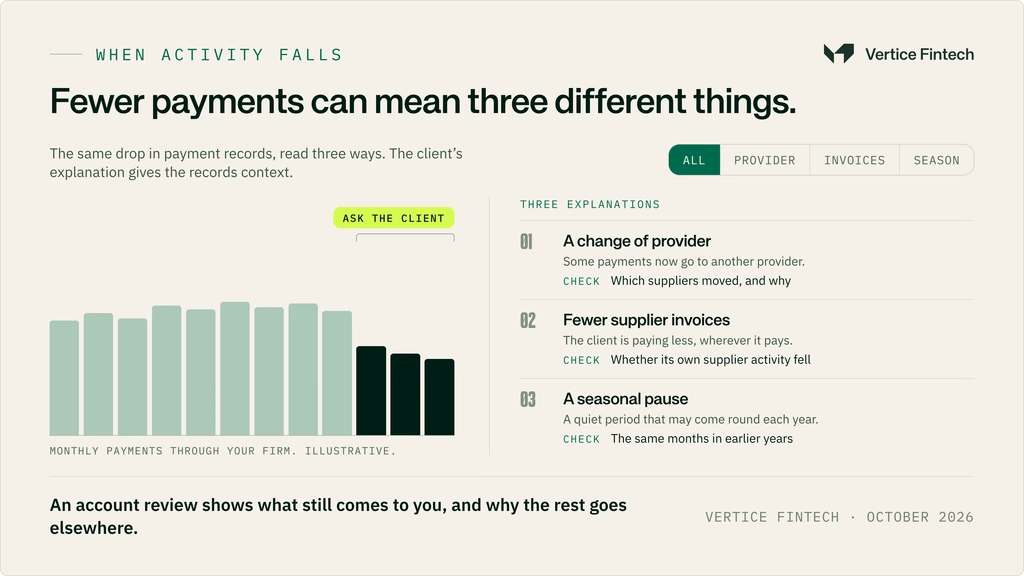
This also helps explain falling activity. Fewer payments through your firm could reflect a change of provider, fewer supplier invoices or a seasonal pause. The client’s explanation gives the payment records context.
For the importer, an account review would show whether it still sends euro payments through your firm and why the dollar business goes elsewhere.
What a client needs from the quote
A clear quote lets the client understand the cost before agreeing to the transfer. It should show the exchange rate and your charges, alongside the expected amount reaching the recipient.
Where another party may deduct a charge that you cannot confirm, explain the uncertainty. State which amounts are confirmed and which are estimates.
Timing belongs in the same conversation. A client paying a supplier needs to understand the conditions behind an arrival estimate, including when you need its funds and complete payment details.
For example, if your quoted arrival time assumes the client funds the transfer before a particular cut-off, that condition belongs beside the estimate. Leaving it for a later email creates room for a different expectation.
The sales team also needs to know when a promise requires confirmation from operations. A confident answer given before the payment route has been checked can create a commitment the team then struggles to meet.
When a client challenges the price, the discussion can cover the actual payment it wants to make: currency, amount, destination and timing. A competing headline rate alone leaves some of those questions unanswered.
Useful answers when a payment is delayed
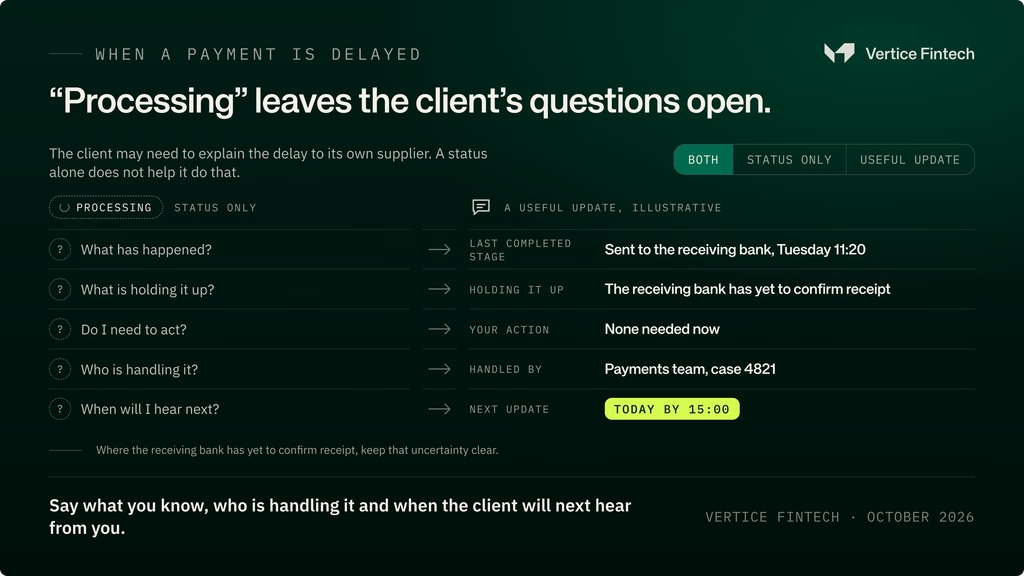
A client asking where its payment is needs information it can use. That could be confirmation of the last completed stage, an explanation of what’s holding it up or a request for missing details.
A status such as “processing” leaves those questions open. If the supplier is waiting, the client may need to explain the delay to someone outside its own finance team.
The answer should describe what your firm knows, who is handling the case and when the client will next hear from you. Where the receiving institution has yet to confirm receipt, that uncertainty needs to remain clear.
Your team needs the same information. If the relationship manager cannot see the payment status, someone must find it before they can answer. A tracking screen that staff cannot use to resolve the query leaves that work outstanding.
If the underlying problem is repeated failure on a payment route, the delivery problem needs attention too. Updates help explain the situation while the team works to resolve it.
A client who calls again should be able to continue the conversation. If it has to retell the problem because a colleague has taken over, the handover needs attention.
A shared case record can hold the last confirmed status, the information already supplied and the promised next update. The colleague taking over also needs to know which partner has been contacted and whether anyone is waiting for a response.
If a refund or exception needs the owner’s approval, that dependency should also be visible. Otherwise, the client may be waiting while the team is unsure who can make the decision.
Service improvements that address client problems
Support conversations can make product spending more specific. A request for “better service” becomes easier to assess when it concerns a recurring problem, such as missing references or unclear payment status.
For example, suppose clients repeatedly contact your team because they cannot match a supplier payment to an invoice. The question for the product team is whether the payment record gives them a usable reference and confirmation.
If clients repeatedly enter information they have already supplied, the team can examine where that repetition occurs and whether the information can be reused appropriately. Any required checks still need to be completed.
Whether the proposal adds a destination or improves tracking, it needs a clear intended result for the clients involved. After launch, usage and support records can show whether those clients use it and whether the original problem has been resolved.
The cost of serving the client
Keeping a client on new terms changes what the account earns. A lower exchange margin or waived fee needs to be considered alongside payment partner charges and the work the account creates.
Suppose a client asks for a lower price while regularly needing manual help with payment details. The proposed terms need to cover the service you intend to provide. Promised future volume is an assumption until the payments arrive.
An operational fix may change those economics. If the client can submit complete instructions and follow the payment without repeated calls, the account may need less staff time. Until you have measured the saving, label it as an estimate in the forecast.
For management reporting, following the same clients over comparable periods helps show whether existing business is continuing. New clients should be visible separately, so growth does not conceal a decline in older accounts.
The payment pattern and the income both deserve attention. A client could keep using the service while sending smaller amounts, choosing different currencies or receiving a lower price. Each would need its own explanation.
If you later consider selling the business, these records also help explain the customer income to a buyer. The relevant evidence is the work clients continue to place with the firm, its earnings and the people needed to provide the service.
Frequently asked questions
Does using another provider mean a client is leaving?
Clients can divide payments between providers. The reason may concern coverage, supplier requirements, pricing or service. Changes in the payments they send through your firm need to be understood in that context.
Should we lower fees to keep a client?
A lower fee is worth assessing when price is the client’s concern. The revised terms need to account for payment costs and the service involved. A complaint about delayed payments also needs a service response.
What should a cross-border payment quote explain?
The exchange rate, your charges, the expected recipient amount and the conditions behind the arrival estimate. Any charge or timing uncertainty outside your control should be clear before the client commits.
What makes a payment update useful?
It tells the client what has happened, whether anything is holding up the transfer and whether it needs to act. Where further investigation is needed, give a contact and a realistic next-update time.
How can we assess whether a service change worked?
Compare the problem before and after the change using comparable payments. Relevant measures include repeat queries, manual corrections and staff time. Returning payment activity is a separate commercial result to track.
Should we improve tracking or add more destinations?
The priority depends on the business involved. Tracking may address problems with existing payments; a new destination may serve a confirmed client need. Each proposal needs evidence of demand, likely use and delivery cost.
What evidence helps explain why clients stay?
Repeat payments show continued use. Client conversations can help explain the reasons, while support and pricing records show what the relationship requires. A survey preference alone cannot establish what caused an individual client to stay.
Research note: Mastercard markets its own payment services alongside this research series. The survey findings describe respondents’ views; they do not establish a retention improvement for an individual provider. Mastercard, 23 September 2026.