
A vendor white paper published on 6 August 2026 says agentic AI is remaking cross-border payments. It is probably right about the technology. It says nothing about what your firm is worth. Two sets of results published the same week do, and they point somewhere else. Buyers are not paying for your software. They are pricing what your software costs you to run.
Three findings decide this, and you can act on all three before your next deal conversation.
Buyers migrate away from the technology they acquire. Automation shows up in your margin, not in your take rate. And an automated process you cannot explain is a discount, not a premium.
What was actually published on 6 August?
A software vendor published a marketing paper. On 6 August 2026, The Paypers hosted a 24-page white paper titled Payments Reimagined with AI: How Agentic AI is Transforming Cross-Border Payments. The paper is written by Volante Technologies, which sells agentic AI payment software to banks. It launched that product, Vol360i, on 9 June 2026.
The paper is worth reading. Volante is a serious firm and the direction it describes is real.
It is not a valuation source. It contains no data on what payment firms sell for, and the company publishing it earns money when firms buy automation. Read it as a product argument, because that is what it is.
That distinction matters right now. Owners are being told automation lifts the price of their firm. Most of the numbers being quoted for that are not sourced. Here are numbers that are.
What do buyers do with payment technology after they buy it?
In at least one large recent case, they moved the volume onto their own. Corpay completed its acquisition of Alpha Group International, a UK cross-border FX business, on 31 October 2025, for about £1.8bn in cash. On its first-quarter call in May 2026, roughly six months after completion, Corpay said 15% of Alpha’s corporate volume had moved onto Corpay’s own technology platform. On its second-quarter call on 5 August 2026, that figure was over 80%.
Fifteen per cent to more than eighty in a single quarter. Nine months from completion.
Now read the rationale, including the part that cuts against this argument. Corpay’s acquisition announcement gave three reasons for buying Alpha: a large and fast-growing corporate payments business, access to European investment managers, and earnings accretion. It also said Alpha’s bank account product and technology extended Corpay’s own cross-border offering. So Corpay did buy technology, and said so.
It still moved more than 80% of the corporate volume onto its own platform inside nine months. Corpay has not published client or deposit retention for Alpha, so nobody outside the deal can say what else held. What is on the record is the migration.
If your price expectation rests on the software you built, a listed buyer has now shown publicly what happens to it. This is not an argument against building good technology. It is an argument against selling it as the asset.
Where does automation actually show up in the numbers?
In margin, not in price per transaction. StoneX reported its quarter ended 30 June 2026 on 5 August. Its Payments segment runs cross-border and FX for banks, financial institutions and corporates, so it is the closest listed read on what an automated operation looks like from the inside.
Four figures, and they need to be read together:
- Average daily volume rose 20%
- Revenue per million fell 7%
- Segment net operating revenue rose 12%, to $56m
- Segment margin rose from 56% to 61%
The obvious reading of a falling revenue per million is that pricing is collapsing. Management gave a different explanation: the mix shifted toward larger, lower-value transactions, and the expanded capacity of its XPay engine now lets it process high-volume flows it previously could not handle. StoneX describes that engine in its 2025 annual report as built to process millions of payments per month rather than per year.
So the automated operator is not defending its take rate. It is processing far more, earning less on each unit, and keeping a bigger share of what it earns. StoneX does not isolate automation as the cause of the margin move, and one quarter cannot prove it. The shape is still worth your attention.
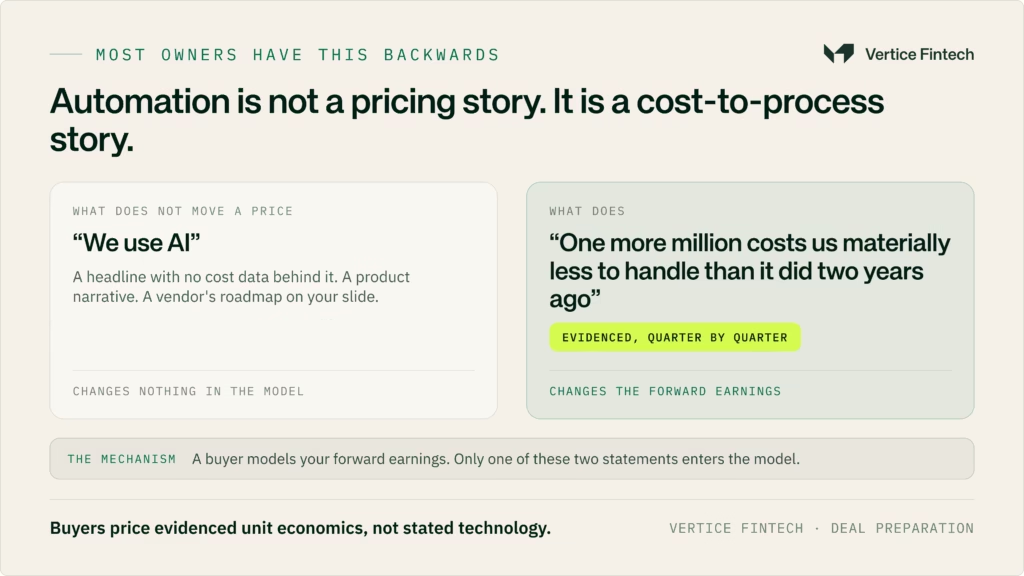
That is the whole point, and most owners have it backwards. Automation is not a pricing story. It is a cost-to-process story. A buyer models your forward earnings. If you can show that one more million of volume costs you materially less to handle than it did two years ago, that changes the model. If your headline is that you use AI, it changes nothing.
The three numbers to have ready
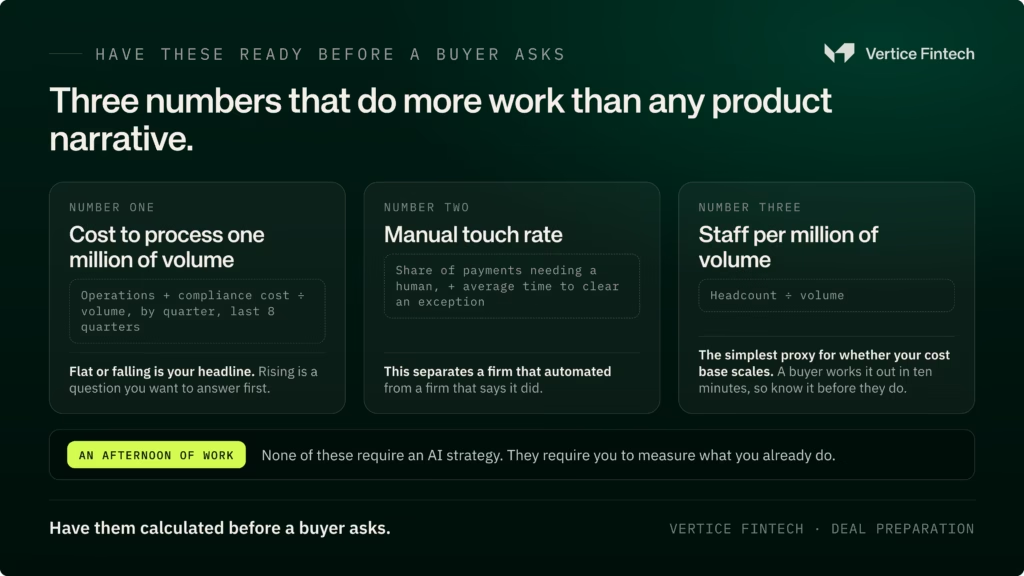
Have these calculated before a buyer asks. They take an afternoon and they do more work in a negotiation than any product narrative.
One. Cost to process one million of volume. Total operations and compliance cost divided by volume, by quarter, for the last eight quarters. A flat or falling line is your headline. A rising one is a question you want to answer first.
Two. Manual touch rate. The share of payments that need a human to intervene, plus average time to clear an exception. This is the number that separates a firm that automated from a firm that says it did.
Three. Staff per million of volume. The simplest proxy for whether your cost base scales. A buyer works this out in ten minutes from your headcount and your volumes, so know it before they do.
None of these require an AI strategy. They require you to measure what you already do.
When does automation reduce the price?
When you cannot show who made the decision. This is the part the vendor papers leave out, and it is where the money is.
Payment systems are built on deterministic logic. Each step has to be predictable, auditable and legally enforceable. Agentic systems work differently. They reason probabilistically and can reach different outcomes from similar inputs. The IMF set out that tension plainly in a note published in April 2026 on how agentic AI will reshape payments.
For a deal, that is not a philosophical problem. It is a diligence problem.
A buyer’s team will ask who approved a payment, why a transaction was screened out, and whether you can produce the record. “The model decided” is not an answer that survives a data room. In our experience of brokered mandates, where a firm cannot evidence the decision trail on transaction monitoring, sanctions screening or pricing, the buyer prices the remediation and takes it off the number. That is our read of how these deals price, not a published finding.
Concentration is the second exposure. If your monitoring, screening and pricing all run on the same small set of vendors that everyone else uses, that is a supervisory concern as well as a commercial one. The Financial Stability Board’s consultation report of 10 June 2026 proposes twelve sound practices for AI adoption. Practice 11 covers cyber and technology risk. Practice 12 covers third-party dependencies and concentration risk. The FSB published the industry responses on 6 August 2026, from respondents including Visa, Mastercard, Wise and UK Finance, and says it expects to publish the final report in the coming months.
Note the limits honestly. The FSB practices are not rules. They create no new obligations and they are not binding on a UK payment institution. They matter because they tell you what a buyer’s risk committee will be reading by the time your deal reaches it.
The direction of travel in the UK points the same way. The FCA opened its Handbook through a new API on 6 August 2026, so the rulebook is now machine-readable. HM Treasury’s consultation on modernising payment services regulation, published 14 July 2026 and open until 6 October, puts agentic payments explicitly in scope. Neither changes your price today. Both tell you where the questions are heading.
Who this is not for
This is not for firms below the volume where processing cost is a real constraint. If you handle low volumes at healthy spreads, your value sits in your permission, your corridors and your client book. Automation is a distraction from a stronger argument.
It is also not for firms that are not yet authorised. Vertice Fintech does not run FCA applications and does not sell compliance work.
One fair counterargument. A buyer acquiring for capability rather than for clients will pay for technology and keep it. Those deals exist. No public dataset shows how often they happen at SPI and API scale, so do not assume you are in one unless a buyer has said so.
What to do before the next conversation
Take the three numbers above and put them in writing.
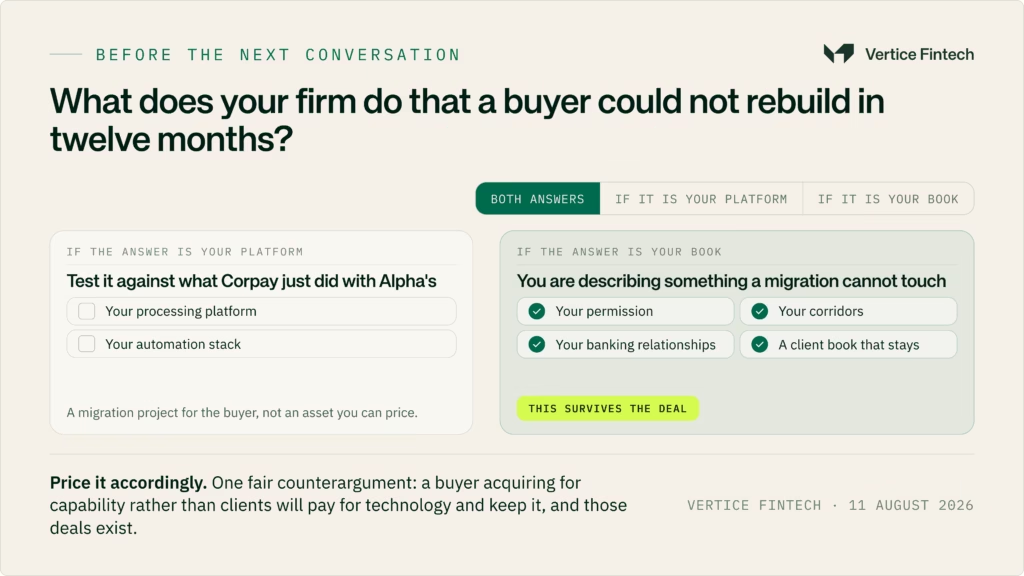
Then take one paragraph and answer a harder question: what does your firm do that a buyer could not rebuild in twelve months? If the answer is your platform, test it against what Corpay just did with Alpha’s. If the answer is your permission, your corridors, your banking relationships and a client book that stays, you are describing something a migration cannot touch.
That is the part that survives the deal. Price it accordingly.
Frequently asked questions
Does agentic AI increase the valuation of a payment institution?
Not on its own. Buyers price evidenced unit economics, not stated technology. Automation raises value when it demonstrably lowers your cost to process volume and you can show the trend. A claim that a firm uses AI, without cost data behind it, does not move a price.
What happens to a payment firm’s technology after an acquisition?
It is often replaced. Corpay moved over 80% of acquired volume from Alpha Group onto its own platform within nine months of completing the deal on 31 October 2025, up from 15% one quarter earlier. Client relationships, corridors and permissions carried through the deal. The processing platform became an integration project.
Does automation improve a payment firm’s take rate?
Usually not. StoneX reported revenue per million down 7% in the quarter ended 30 June 2026, while average daily volume rose 20% and segment margin improved from 56% to 61%. Automation showed up in margin, not in price per transaction.
What metrics should a seller prepare on operational efficiency?
Three. Cost to process one million of volume, tracked quarterly over eight quarters. Manual touch rate, with average exception resolution time. Staff per million of volume. Each is calculable from data you already hold, and a buyer will derive them anyway.
Can AI in compliance reduce the sale price of an SPI or API?
In our experience it can. Buyers test whether you can show who approved a payment and why a transaction was screened. Where those decisions cannot be evidenced, we see buyers price the remediation cost and deduct it. Published regulatory sources address governance rather than deal pricing, so treat this as our read of the market.
Is the FSB guidance on AI binding on UK payment institutions?
No. The Financial Stability Board proposed twelve sound practices in a consultation report on 10 June 2026 and published the responses on 6 August 2026. They are proposals, not rules, and create no new obligations. A final report is expected in the coming months. They matter commercially because acquirers and their risk committees use them as a diligence reference.
Does UK regulation cover agentic payments yet?
There is no separate agentic-payments regime, but existing rules still apply to a firm that uses AI. The Payment Services Regulations 2017 remain in force, and your obligations do not change because a model made the decision. HM Treasury’s consultation on modernising payment services regulation, published 14 July 2026 and closing 6 October 2026, puts agentic payments in scope for the future framework.
Should a seller delay a sale to automate first?
Rarely. Measuring and evidencing existing efficiency usually moves a price faster than a new automation programme, and a programme that is mid-flight at completion reads as execution risk. Automate because the economics justify it, not to stage a valuation.