
In a share sale that gives a buyer control of a UK payment or e-money institution, the buyer must notify the FCA and obtain approval before control changes. Acquiring control without approval is a criminal offence under section 191F of the Financial Services and Markets Act 2000.
So agreed terms are a milestone, not an outcome. The gap between the two is where deals slip.
On the FCA’s own published figures, the regulator is rarely the reason. Its statutory deadline is 60 working days from a complete notification. Its published quartiles for the first quarter of 2025/26 show 251 cases with a median determination of 40 calendar days and an upper quartile of 70, measured end to end from receipt.
In our experience the delay sits upstream of the assessment, in the file that reaches it. That is a view from running these transactions, not a finding in the FCA data, and this article labels the difference throughout.
Why does a payment institution deal slip between agreed price and completion?
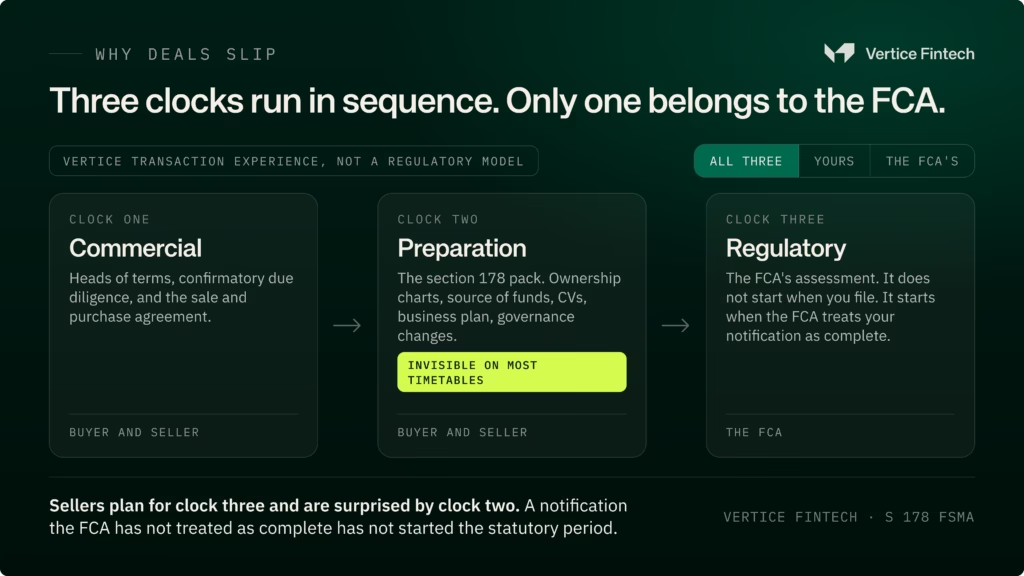
Three clocks run in sequence, and only one of them belongs to the FCA. This framing is Vertice’s transaction experience rather than a regulatory model.
Clock one is commercial. Heads of terms, confirmatory due diligence, and the sale and purchase agreement.
Clock two is preparation. Assembling the section 178 notification pack. Ownership charts, source of funds evidence, CVs, business plan, governance changes. This clock is invisible on most deal timetables, which is exactly why it overruns.
Clock three is regulatory. The FCA’s assessment. It does not start when you file. It starts when the FCA treats your notification as complete.
Sellers plan for clock three and are surprised by clock two. The regulatory point underneath is documented: a notification the FCA has not treated as complete has not started the statutory period.
What has to be true before you can complete
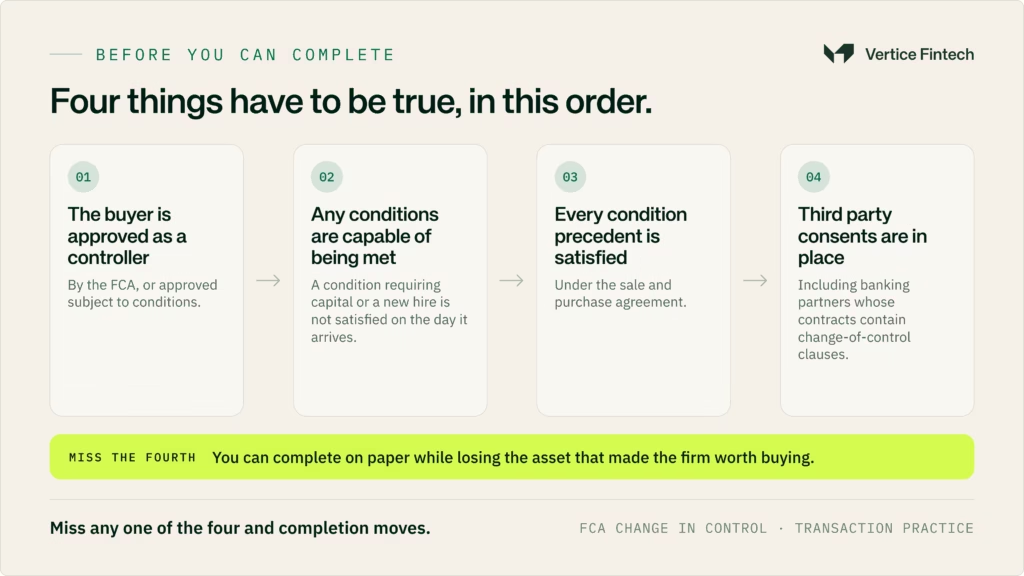
Four things, in this order:
- The buyer has been approved as a controller by the FCA, or approved subject to conditions
- Any conditions attached to that approval are capable of being met
- Every condition precedent in the sale and purchase agreement is satisfied
- Consents from third parties are in place, including banking partners whose contracts contain change-of-control clauses
Miss any one and completion moves. Miss the fourth and you can complete on paper while losing the asset that made the firm worth buying.
What is FCA change of control, and when does it apply?
FCA change of control is the approval a buyer must obtain before acquiring or increasing control in an authorised firm. It applies to authorised payment institutions and electronic money institutions, and it is triggered by shareholding, by voting power, or by influence.
Notifications are made under section 178 of FSMA and submitted through the FCA’s Connect system. Approval must come before the transaction takes place, not after.
The control bands that apply to a payment institution
Payment institutions and e-money institutions use the same four bands as banks and investment firms. They do not use the single 20% band that applies to non-directive firms.
| Band | Holding of shares or voting power |
|---|---|
| Band 1 | 10% or more, less than 20% |
| Band 2 | 20% or more, less than 30% |
| Band 3 | 30% or more, less than 50% |
| Band 4 | 50% or more |
Two further triggers sit alongside the percentages, and they catch people out.
Significant influence. A holding that lets a person exercise significant influence over the management of the firm makes them a controller, whatever the percentage says.
Acting in concert. Where parties act together, their holdings are aggregated. Family shareholdings and connected investors are commonly caught. Each person in the concert party is then a controller in their own right.
The FCA also treats parent undertakings of minority shareholders as controllers. In a layered structure, the list of people needing approval is usually longer than the buyer first assumes.
Restructures that count as a change of control
Inserting a holding company above the authorised firm requires prior approval, even where the ultimate owner does not change. This surprises founders doing pre-sale reorganisations, and it is a common reason a tidy-up before going to market becomes its own regulatory project.
If you plan to restructure before a sale, treat the restructure as a change-of-control event and time it accordingly.
How long does FCA change of control approval take?
The statutory deadline is 60 working days from the point the FCA acknowledges a complete section 178 notification. That is at least 84 calendar days.
Inside that period the FCA may pause the clock once, for up to 30 days, to request further information. The power to interrupt sits in section 189 of FSMA, and section 190 requires the interruption to fall within the first 50 working days of the assessment.
So the statutory ceiling from a complete notification is roughly 84 days plus a possible 30 day pause. Then add however long it takes to get to “complete”.
| Stage | Who controls it | Typical driver of delay |
|---|---|---|
| Preparing the section 178 pack | Buyer and seller | Missing source of funds evidence, incomplete ownership charts |
| FCA accepts notification as complete | FCA, on your documents | Gaps in the pack, unidentified controllers |
| Assessment, 60 working days | FCA | Complexity, unresolved matters |
| Interruption, up to 30 days, once | FCA | Requests for further information |
| Approval, or approval with conditions | FCA | See the section below |
| Completion under the sale agreement | Buyer and seller | Third-party consents, conditions precedent |
| Notifying the FCA of the change | Buyer and the firm | Left until after completion, when it should be raised early |
For context, and this is performance data rather than a rule, the FCA publishes quartiles for determination times. Its figures for the first quarter of 2025/26 showed a median of around 40 calendar days and an upper quartile of around 70, measured end to end from receipt. Change in control is also the one area where the FCA holds itself to a 100% standard rather than the 95% it applies elsewhere.
Read that against the 84 day ceiling. Most cases are decided well inside the statutory window. Our reading, and it is a commercial judgement rather than an FCA finding, is that a slipping deal usually has a file problem rather than a regulator problem.
Approval is not binary, and most sellers do not price the third outcome
There are three possible results, not two. Approve. Approve with conditions. Object.
The middle one used to be rare. It is now easier for the FCA to reach.
Section 187(2)(aa) of FSMA, inserted by the Financial Services and Markets Act 2023, lets the regulator impose conditions on a controller. The test is whether it appears desirable to do so in order to advance any of the regulator’s objectives.
The significant part is what changed. Before 2023, conditions could only be imposed where the regulator would otherwise have objected. Now they can be attached even where there are no grounds to object at all.
This applies to notifications received on or after 29 August 2023. The FCA set out how it will use the power in Chapter 5 of its finalised guidance FG24/5, published on 1 November 2024, which replaced the old European guidelines. One example the FCA gives is an unresolved matter whose outcome is uncertain, such as outstanding proceedings against a proposed controller.
The regulator cannot impose a condition requiring a controller to acquire a particular size of holding. Beyond that, the scope is wide.
What conditional approval does to your deal
It converts a clean binary into a negotiation, and it does so after the price is agreed.
A condition can require additional capital in the firm. It can require a governance change, a person in a named role, or a reporting commitment for a defined period. Each of those has a cost, and the sale agreement usually has not allocated it.
Three practical consequences follow.
Your sale agreement needs to say what happens. Draft for conditional approval explicitly. Who bears the cost of satisfying a condition? Does a condition above a stated threshold give either side a right to walk? Silence here is how a completed deal turns into a dispute.
Your long-stop date needs headroom. A conditional approval that requires an injection of capital or a new hire is not satisfied on the day it arrives.
Disclosure matters more than it used to. An unresolved matter that the buyer discloses can be managed, sometimes through a condition. The same matter discovered by the FCA halfway through the assessment reopens every question already answered.
What the FCA is actually assessing
The assessment procedure sits in sections 185 and 186 of FSMA, and the criteria are set out in Chapter 4 of FG24/5. Knowing them changes how you build the file, because you can answer each one directly instead of hoping the narrative covers it.
Five criteria drive the decision.
Reputation of the proposed controller. Integrity and professional conduct. Criminal, civil, regulatory and disciplinary history, for the controller and for anyone with influence over it.
Reputation, knowledge, skills and experience of the people who will direct the business. This means the board and senior managers after the deal, not before it. If the buyer is installing new people, the FCA is assessing them here.
Financial soundness of the proposed controller. The FCA looks at capacity to finance the acquisition and to support the firm afterwards. The guidance is explicit that the nature of the buyer matters. A strategic trade buyer and a private equity fund are read differently, including on their capacity to provide further capital in the short to medium term.
Whether the firm can still meet its prudential requirements. Threshold conditions, capital, liquidity, governance, risk management and controls. This limb also covers the group the firm is joining, including whether that structure allows effective supervision. Joining a group is not a separate test. It is assessed here.
Money laundering and terrorist financing risk. This one is different in kind. Where there are reasonable grounds to suspect that money laundering or terrorist financing is being or has been committed or attempted, or that the risk could increase, the regulator will object. It is not weighed against the others.
For a seller, the practical read is simple. Three of those five criteria are about the buyer. Two are about your firm and the group it will join. You cannot fix the buyer, but you can make sure the two that describe your business do not create a problem.
The obligation sellers forget
The buyer is not the only party with a statutory duty.
Under section 191D(1) of FSMA, a person who decides to reduce or cease control over a UK authorised person must give the regulator notice in writing before making the disposal. Before, not after.
Breach of that obligation is a criminal offence, as is breach of the buyer’s obligation to notify. The courts can impose unlimited fines and, in some cases, imprisonment.
This is routinely missed because seller-facing guidance focuses on the buyer’s approval. If you are selling down or exiting entirely, you have your own filing to make, and its timing is tied to your decision rather than to completion.
Seven things that actually stall completion
These are Vertice’s observations from running these transactions, not findings published by the FCA. The regulatory requirements behind each one are sourced. The frequency ranking is ours.
1. An incomplete section 178 pack. The clock does not start. Documentation gaps and unclear narrative explanations lead directly to follow-up questions and a paused assessment.
2. Weak source of funds evidence. The FCA wants the cost of the acquisition and the source of the money, with supporting evidence. A buyer who cannot evidence the funding trail cleanly will be asked again, and the pause will be used.
3. Undisclosed regulatory history. Past supervisory contact, remediation, a withdrawn application. It surfaces. Disclosed, it is a fact to be managed. Discovered, it becomes a question about everything else you said.
4. Safeguarding evidence that does not match the permission. Where an API or EMI receives relevant funds, safeguarding records are a key diligence item. An SPI is not generally required to safeguard, although it may elect to. From 7 May 2026 the FCA’s strengthened regime requires safeguarding institutions to keep more structured records and submit monthly safeguarding returns. The obligation follows the funds and the activity, not the label on the permission. Know which applies to you, and be able to say so plainly with records to match.
5. Banking and scheme contracts with change-of-control clauses. Safeguarding accounts, sponsor banks, scheme memberships, key supplier agreements. Read every one of them for a change-of-control provision before you sign heads of terms. A consent you assumed was routine can take longer than the FCA assessment.
6. Changes to the people running the business. If completion changes the people responsible for payment or e-money services, identify the necessary FCA Connect notifications early. Payment institutions do not sit under the Senior Managers and Certification Regime, so the requirements are not the same as for a Part 4A firm. Work out which notifications actually apply to your permission before you assume the position.
7. Controllers nobody identified. Indirect holders, parents of minority shareholders, concert parties. Every one of them needs their own notification. Finding the fifth controller in month three is a common way to lose a quarter.
How to structure a deal around the regulatory clock
The regulatory sequence is fixed. The commercial structure is not. Build the second around the first.
Conditions precedent and the long-stop date
FCA approval is a condition precedent to completion, not a formality after it. Draft it that way. Set the long-stop date against the realistic outer edge of the process. That means the time to reach a complete notification, plus the statutory window, plus a possible interruption, plus room to satisfy any condition attached to the approval.
A long-stop date set on optimism is a renegotiation waiting to happen. When it passes, the buyer gets a free option to revisit price.
Deferred consideration and earn-outs without creating a controller
Earn-outs are useful in regulated deals because they bridge a valuation gap where the buyer cannot get comfortable. They also create a trap.
If deferred consideration is structured as retained equity, or if it comes with voting rights, board rights or veto rights, the seller may remain a controller after completion. That is a separate regulatory position, not a commercial detail. Consider whether the retained rights amount to significant influence, and check the answer before the structure is agreed rather than after.
The cleaner structures for a regulated firm usually keep the deferred element as cash and leave control unambiguous.
Escrow, warranties and the regulatory gap
The period between signing and completion is a real exposure. The seller still runs the firm. The buyer carries the risk of what happens to it.
Escrow and specific indemnities are the usual tools, and in a regulated transaction they should be pointed at regulatory outcomes rather than only at financial ones. A specific indemnity for a known open regulatory matter is worth more than a general warranty that covers everything and settles nothing.
What not to do
Do not complete before approval. Not on a handshake, not on a side letter, not on a plan to notify afterwards.
Acquiring control without prior approval is a criminal offence. If it has already happened, the FCA expects a post notification as soon as possible. That is a remediation route, not a strategy.
Do not leave the firm’s own notification to the end either. Under regulation 37 of the PSRs, an authorised payment institution must tell the FCA about changes to the circumstances relevant to its authorisation. The FCA’s guidance is to discuss any prospective change of control at the earliest opportunity, rather than waiting for a formal trigger.
A note on where the rules come from, because it matters. Payment institutions are not authorised under Part 4A of FSMA. Part 12 of FSMA, the controllers regime, is applied to them by Schedule 6 of the PSRs with modifications. Handbook chapters written for Part 4A firms do not automatically carry across. If an adviser quotes you a Handbook rule, check that it applies to a payment institution before you build a timetable on it.
What is changing, and what to watch
Two developments are worth tracking if you expect to transact in the next 18 months.
Faster targets. The FCA has begun working voluntarily towards reduced determination timelines, ahead of any legislation, as part of its growth work. The Government has separately consulted on proposed statutory deadlines. The FCA publishes its performance quarterly, and its first quarter 2026/27 figures are due in August 2026. If the faster targets hold, the regulatory clock shortens and the preparation clock becomes an even larger share of the total.
Safeguarding as a documented trail. The regime that came into force on 7 May 2026 produces monthly records for safeguarding institutions. Over a full year that becomes an evidence trail a buyer can review rather than a position a seller can assert. Sellers with clean records will find diligence faster. Sellers without them will find the opposite.
What this means if you are selling
Start the regulatory preparation before you start the price conversation, not after.
The buyer will build the section 178 pack, but roughly half of what goes in it describes your firm. Ownership structure, governance, regulatory history, safeguarding position, contracts with change-of-control clauses. Every one of those can be assembled now, while nothing is under time pressure and no counterparty is watching.
Sellers who do this compress the preparation clock, which is the clock they actually control. Sellers who do not spend month three answering questions they could have answered in week one, with a buyer growing less patient by the week.
Frequently asked questions
How long does FCA change of control approval take for a payment institution?
The FCA has 60 working days, at least 84 calendar days, from acknowledging a complete section 178 notification. It may pause once for up to 30 days to request more information. Published FCA quartiles show most cases determined well inside that window, with a median of around 40 calendar days end to end.
Do I need FCA approval to sell my SPI, API or EMI?
The buyer needs approval, and it must be obtained before the transaction takes place. Approval is required once a person reaches a control band of 10% or more of shares or voting power, or acquires significant influence. Acquiring control without prior approval is a criminal offence under section 191F of FSMA.
What are the control bands for a UK payment institution?
Payment institutions and e-money institutions use four bands. These are 10% or more but under 20%, 20% or more but under 30%, 30% or more but under 50%, and 50% or more. Significant influence is a separate trigger. Parties acting in concert have their holdings aggregated.
Can the FCA approve a change of control with conditions attached?
Yes. Section 187(2)(aa) of FSMA, added by the Financial Services and Markets Act 2023, allows the FCA to impose conditions where it is desirable to advance its objectives. It can do so even where it has no grounds to object. This applies to notifications received on or after 29 August 2023, and FG24/5 sets out the approach.
What is a section 178 notice?
A section 178 notice is the change in control notification a proposed controller submits to the FCA before acquiring or increasing control in an authorised firm. It is filed through Connect and covers the controller’s identity, ownership structure, financial standing, source of funds, regulatory history and intentions for the firm.
Does inserting a holding company require FCA approval?
Yes. Inserting a holding company above an authorised firm is a change of control requiring prior approval, even where the ultimate controller does not change. The new holding company is a new controller. Pre-sale restructures should be planned with this in mind and timed accordingly.
What happens after the deal completes?
Any conditions attached to the approval must be met on their stated terms. Under regulation 37 of the PSRs, the firm must keep the FCA informed of changes to the circumstances relevant to its authorisation. If the people responsible for payment or e-money services have changed, the necessary Connect notifications should already have been identified before completion.
Does the seller have to notify the FCA as well as the buyer?
Yes. Under section 191D(1) of FSMA, a person who decides to reduce or cease control over a UK authorised person must notify the regulator in writing before the disposal takes place. Breaching that obligation is a criminal offence, in the same way as acquiring control without approval.
Why do payment institution deals fall through?
Rarely on price after terms are agreed. The common causes are an incomplete notification pack that never starts the regulatory clock, undisclosed regulatory history, and third-party consents under change-of-control clauses. Controllers identified late and long-stop dates set too tight to survive a conditional approval account for most of the rest.
The short version
Agreed price is a milestone, not an outcome. In a UK regulated payments deal, completion depends on a regulator approving a buyer, on your documents, on your timetable.
Three things follow. The FCA is usually faster than sellers expect, so the delay is normally upstream of it. Approval is not binary, and a conditional approval after the price is agreed will find whatever your sale agreement failed to allocate. And the preparation clock is the one clock a seller genuinely controls, which makes it the one worth starting early.
Vertice Fintech brokers SPI, API and EMI transactions in the UK, on both sides, and manages the FCA change-of-control handover. Rodolfo Basilio has been operating in UK payments since 2007.