
The FCA part has a set timetable. The rest of the deal does not. Here is each stage, what sets its pace, and what you can do to shorten it.
How long does it take to buy a UK payment institution? The FCA usually decides on a change in control within about six weeks. The whole purchase takes longer, because the FCA stage sits in the middle of the deal, not at the start.
Buyers often plan around the regulator alone. That leaves out most of the deal. The FCA works to a legal deadline, and in recent figures it met every one. Most of the other stages have no legal deadline. They move as fast as the seller’s records, the buyer’s own file and the bank behind the business allow.
This guide breaks the purchase of an SPI (small payment institution), an API (authorised payment institution) or an EMI (electronic money institution) into eight stages. For each one, it shows what happens, what sets the time, and the published figure where one exists. It uses two deals made public in October 2026 to show how buyers plan for time and cash.
This guide covers buying shares in a payment firm, where the buyer becomes a controller and needs FCA approval. Buying a small minority stake, or buying only assets, can follow a different route.
The short answer
- The FCA decision: half of all change-in-control decisions took 43 calendar days or less, counted from the day the FCA received the notice (FCA figures, April to June 2026). These figures cover all firms the FCA alone regulates, not only payment firms.
- The legal timetable: once the FCA accepts the notice as complete, it has 60 working days to decide. It can pause once to ask questions, for up to 30 working days unless the buyer is a UK bank, insurer, investment firm or UCITS fund manager (then 20). In total, that is about 18 weeks. If the FCA proposes conditions or objects, the process can run longer.
- The rest of the deal: we found no reliable public figures for preparation, due diligence, negotiation or bank consents. These stages depend heavily on how ready the seller and the buyer are.
- How one buyer planned: in a deal agreed on 6 October 2026, the buyer agreed a long-stop date 12 months after signing. A long-stop date is the date when either side can walk away if the deal has not completed.
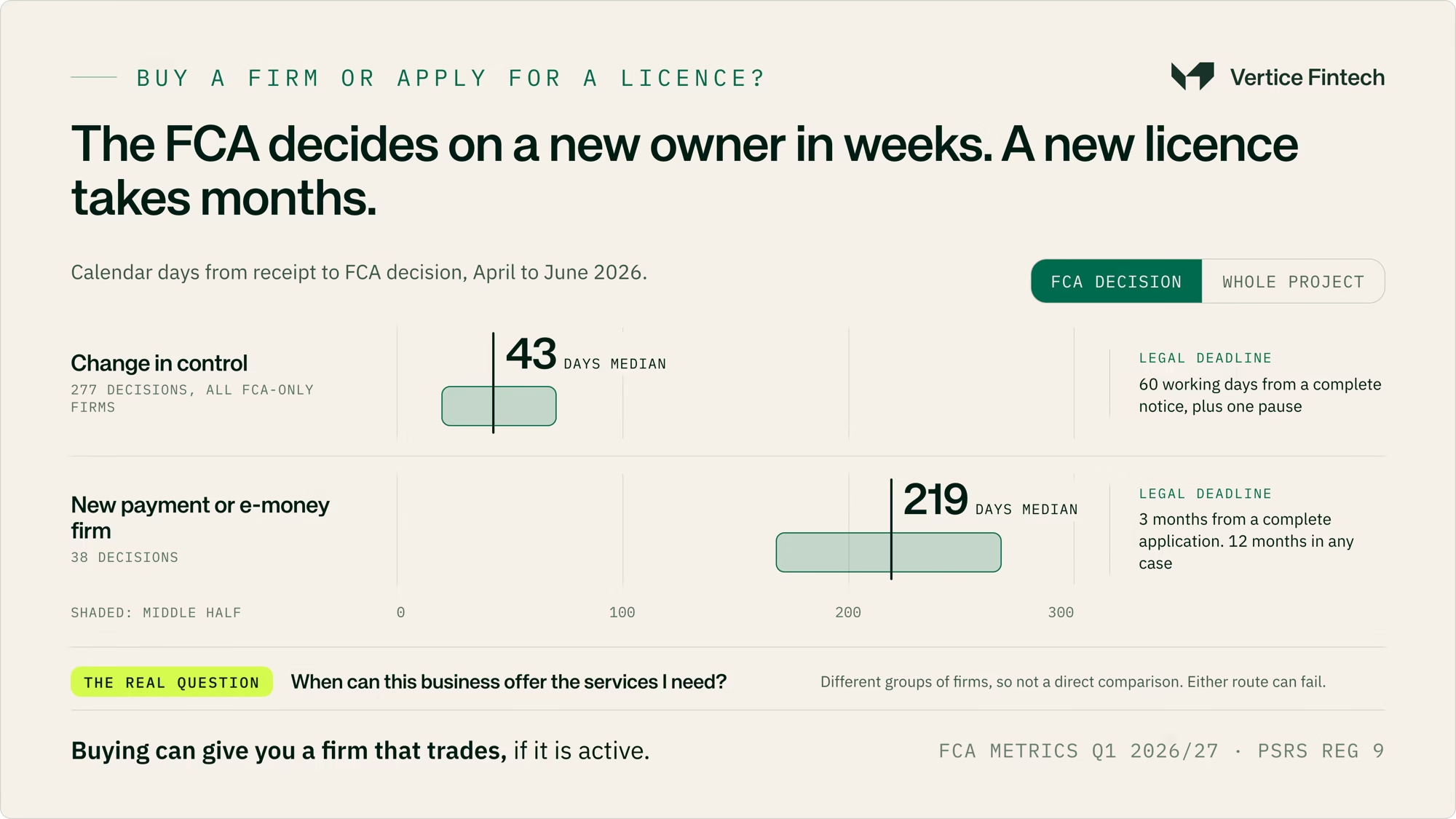
- Buying against applying: the FCA decides on a new owner in weeks. A new licence takes months: new payment and e-money firm applications took a median of 219 days in the same period. Neither figure covers the whole project.
How long does it take to buy a UK payment institution, stage by stage?
A purchase has eight stages. They do not have to run one after another. Several can run at the same time. The buyer can notify the FCA once it has decided to buy, and the deal cannot complete until the FCA has approved it.
| Stage | What happens | What sets the time | Published figure |
|---|---|---|---|
| 1. Seller preparation | The seller gathers accounts, safeguarding records, policies and contracts | How organised the records already are | None |
| 2. Finding the match | Buyer and seller meet, share basic information and sign a confidentiality agreement | The size of the buyer pool and how clear the asset is | None |
| 3. Heads of terms | Both sides agree the main terms on paper: price, structure, exclusivity | The gap between the two sides on price and structure | None |
| 4. Due diligence | The buyer checks the business, the licence, the money and the risks | The quality of the seller’s records | None |
| 5. Signing the sale agreement | Lawyers agree the share purchase agreement (SPA) and sign it | Warranties, indemnities and payment terms | None |
| 6. FCA change in control | The buyer files a section 178 notice and the FCA assesses it | Whether the notice is complete, and the buyer’s own record | Median 43 calendar days; legal assessment period 60 working days plus one pause |
| 7. Other consents | Banks, payment partners and, in some deals, other regulators or the government | Contract terms and the counterparty’s own process | None for banks; set deadlines for government review |
| 8. Completion and handover | Money and shares change hands; the firm updates the FCA | How well the handover was planned | None |
Two things stand out. First, the FCA stage is the only one with a legal deadline in every deal. A national security review, where it applies, also has set periods. The other stages run on contract dates, or none. Second, slow preparation and due diligence can delay the FCA notice, because the buyer needs that information for its file.
Before the FCA: preparation, terms and due diligence
The stages before the FCA have no published averages. They are also the stages a buyer and seller control most.
Seller preparation
A prepared seller can open due diligence quickly. An unprepared one spends time finding documents before the buyer can start.
The documents a buyer will usually ask for:
- accounts (audited where available or required) and recent management accounts
- safeguarding records, where the firm safeguards: reconciliations, the monthly safeguarding return to the FCA (called REP027), audit reports and the resolution pack, which is the file that shows how customer money would be returned if the firm failed
- all FCA correspondence, including any open questions
- bank and payment partner contracts, especially the clauses on a change of owner
- customer complaints and how each was closed
- policies for anti-money laundering and fraud
The FCA’s new supplementary safeguarding rules took effect on 7 May 2026[1]. Which records apply depends on the firm: safeguarding is optional for SPIs. Where they apply, put them near the top of the list. Gaps can lead to more questions, a lower price, extra conditions or a buyer walking away.
Heads of terms
Heads of terms are a short document that sets out the main deal terms before the lawyers draft the full agreement. They usually include price, how it is paid, what is included, and a period of exclusivity.
The time here depends on how far apart the two sides are. A clear price based on real numbers closes the gap faster. A price based only on the value of the licence takes longer, because the buyer will test it.
Due diligence
Due diligence is the buyer checking what it is buying. For a payment institution, it has three parts.
- The licence. The FCA register entry, the exact permissions, any requirements or restrictions, and every open question from the FCA.
- The money. Safeguarding, capital, revenue by type and by customer, and bank arrangements.
- The business. Customers, payment corridors (the countries money is sent to and from), partners, staff and systems.
Every gap in the records adds time. Each question goes back to the seller, waits for an answer, and often leads to a second question. Preparation is one of the few parts of the timeline a seller fully controls. Our guide on what buyers actually pay for covers what buyers look for in more detail.
How long does FCA change-in-control approval take?
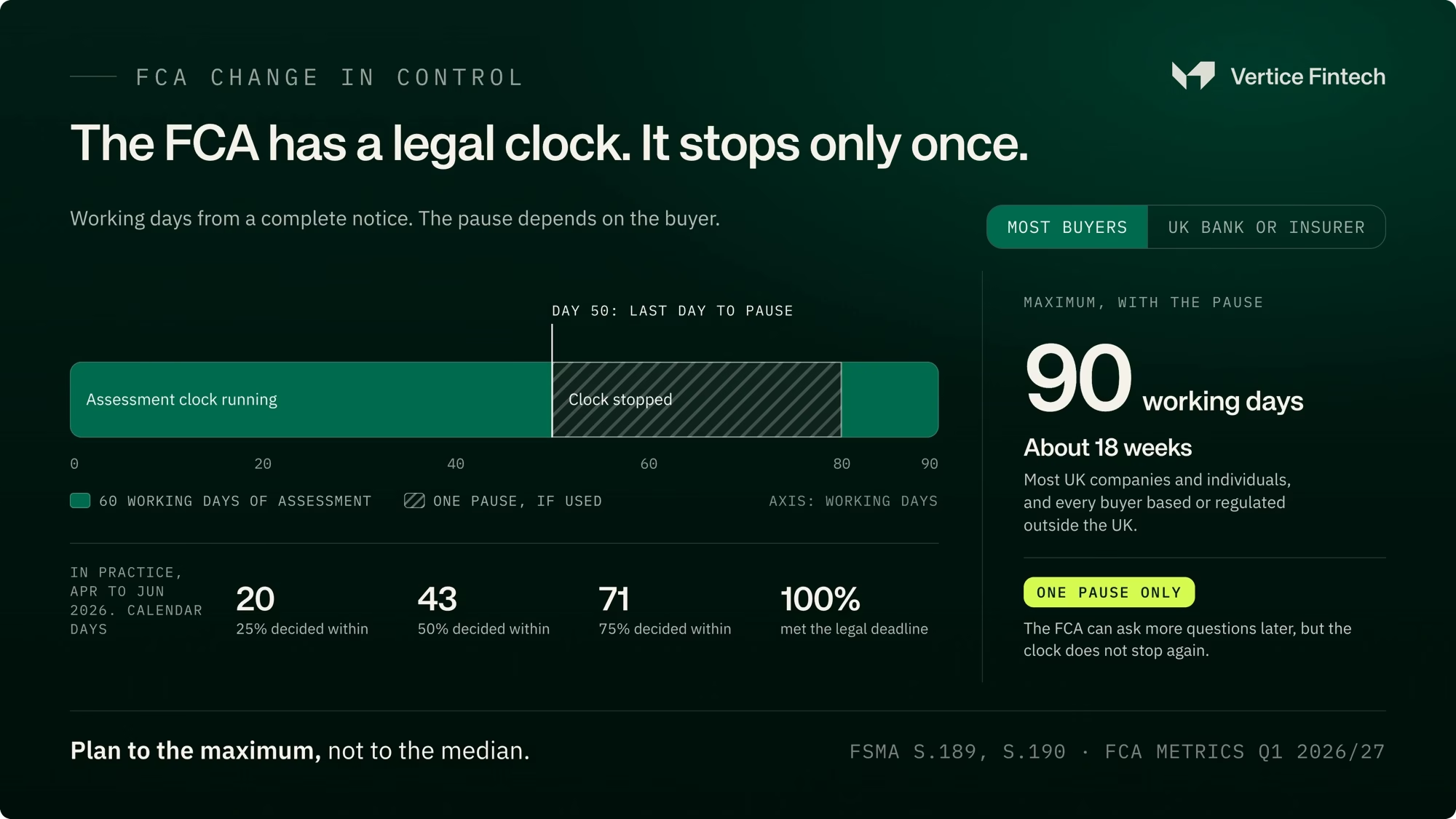
The FCA usually decides within about six weeks. The legal assessment period is 60 working days once the FCA accepts the notice as complete, plus one pause.
The published figures
The FCA publishes its own performance every quarter. For April to June 2026, it decided 277 change-in-control cases[2]:
- a quarter were decided within 20 calendar days
- half were decided within 43 calendar days
- three quarters were decided within 71 calendar days
- 100% met the legal deadline
These days count from the day the FCA received the notice, complete or not. They cover every firm the FCA alone regulates, not only payment firms. They count decisions, not approvals. So treat them as a guide to the FCA’s pace, not a promise for one deal.
The legal clock
The law sets the assessment period. The FCA has 60 working days to decide, starting on the day it acknowledges a complete notice[3]. The FCA says this is at least 84 calendar days.
The FCA can stop the clock once to ask for more information[4]. It must ask by working day 50. The FCA can ask more questions later, but the clock does not stop again.
How long the pause can last depends on who the buyer is. It is limited to 20 working days only for buyers supervised in the UK as a bank, insurer, investment firm or UCITS fund manager. For everyone else it can last up to 30 working days. That includes most UK companies and individuals, and any buyer based or regulated outside the UK.
Add those together:
| Buyer | Assessment period | Maximum pause | Total, in working days | Roughly |
|---|---|---|---|---|
| UK bank, insurer, investment firm or UCITS fund manager | 60 working days | 20 working days | 80 | 16 weeks |
| Every other buyer, in the UK or abroad | 60 working days | 30 working days | 90 | 18 weeks |
Bank holidays make these a little longer in calendar terms. These totals cover the FCA’s assessment only. They do not include time before the notice is complete, or the rest of the deal.
The clock starts only when the file is complete
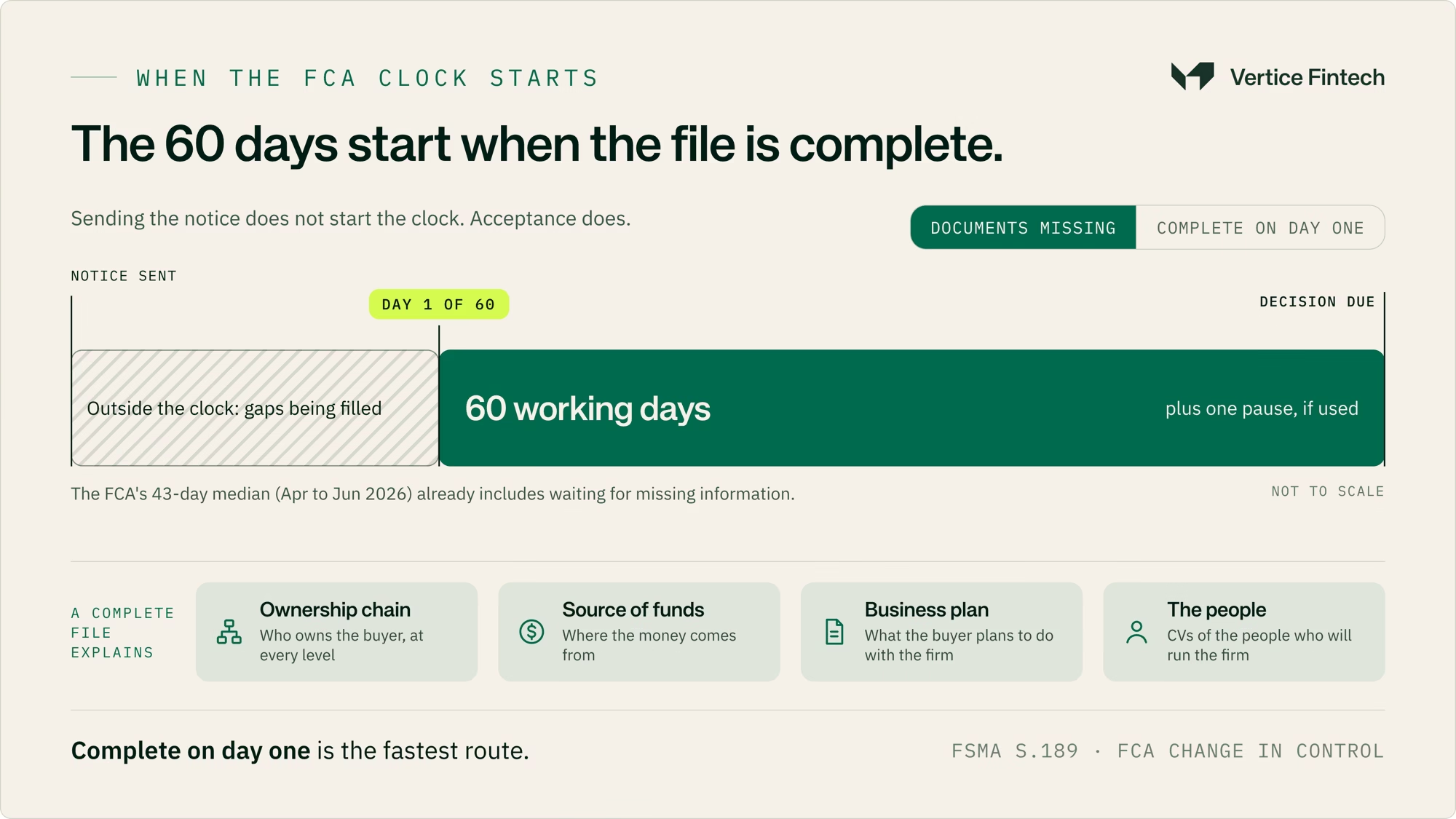
The 60 days do not start when you send the notice. They start when the FCA accepts it as complete. A notice with missing documents sits outside the clock until the gaps are filled.
Missing information is a common and avoidable delay. The FCA’s median of 43 days already includes time spent waiting for it. A complete notice on day one gives the clock the best chance to start straight away.
What the FCA checks
The FCA assesses the buyer, not just the target. The law lists six things[5]:
- the buyer’s reputation
- the reputation, knowledge, skills and experience of the people who will run the firm
- the buyer’s financial soundness
- whether the firm will keep meeting its capital and other prudential requirements after the sale
- whether the group structure lets regulators supervise it properly, share information and know who is responsible for what
- whether there is a risk of money laundering or terrorist financing
The buyer must explain where its money comes from, who owns it at every level, and what it plans to do with the firm. A clear plan and a clean ownership chain reduce avoidable questions. They do not guarantee approval.
What happens at the end of the period?
By the end of the period, the FCA must either approve the purchase or send a warning notice. A warning notice says it plans to approve with conditions, or to object[3]. A decision notice follows, and the buyer can take it to the Upper Tribunal. So a deal with conditions or an objection can run past the 60 days.
In law, if the FCA does neither, and has not said the notice is incomplete, the purchase is treated as approved (section 189(6)). Buyers should not plan around this. The FCA met every deadline in April to June 2026.
Does this apply to an SPI?
Yes. The change-in-control rules apply to SPIs as well as APIs[6]. They also apply to e-money firms[7]. The process is the same, but the questions the FCA asks can differ from deal to deal. Completing without approval is a criminal offence[8]. Our article on FCA change of control explains the control thresholds and who counts as a controller.
What else can slow down completion?
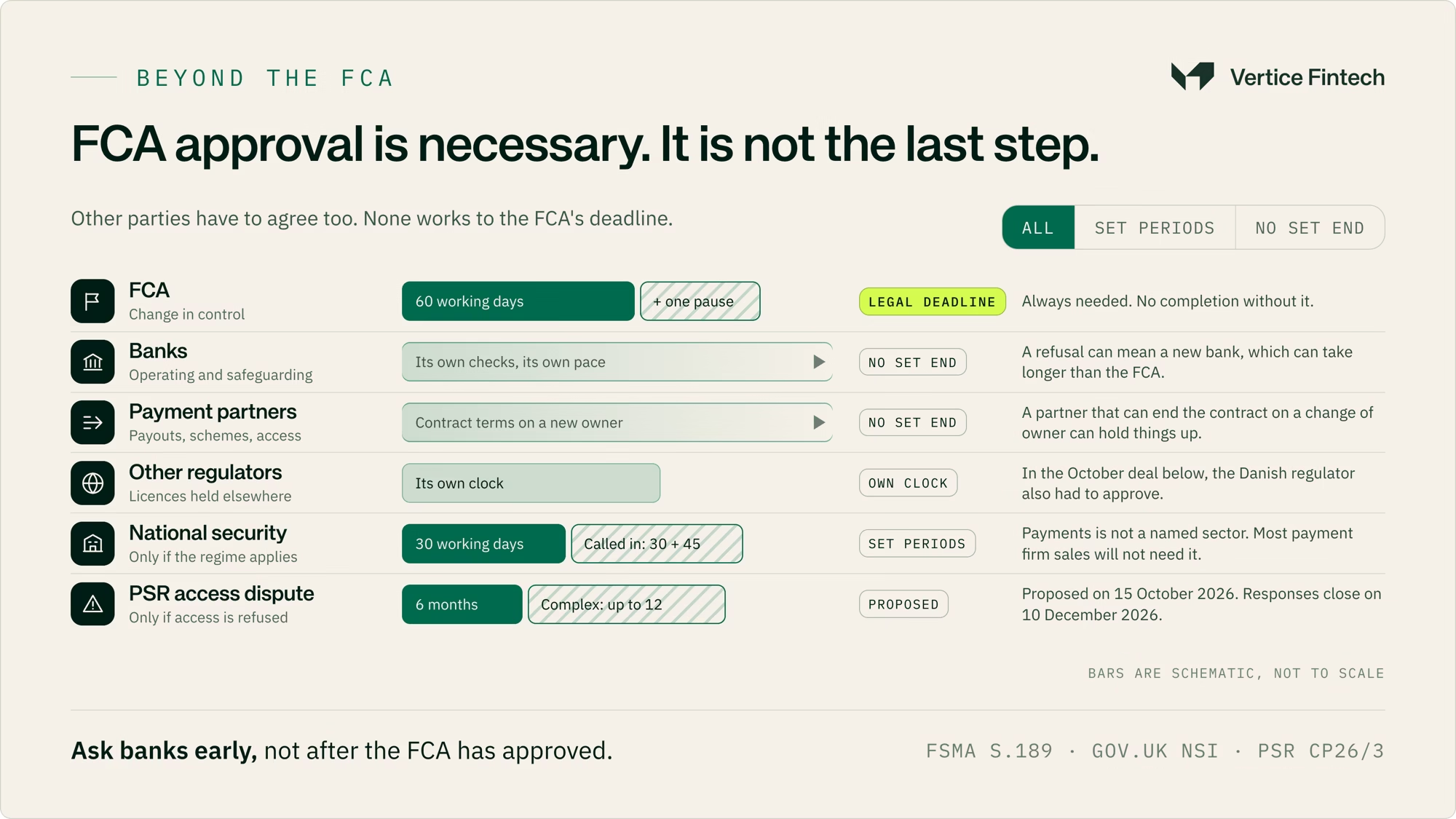
FCA approval is necessary, but it is not the last step. Other parties have to agree too, and none of them works to the FCA’s deadline.
Banks and safeguarding accounts
A payment institution depends on its banks for its operating and, where it safeguards, safeguarding accounts. Bank contracts may require notice, consent or a review when the owner changes. Check what each contract actually says.
A bank that needs to onboard a new owner runs its own checks. It sets its own pace. If the bank says no, the firm may need a new bank before completion, and that can take longer than the FCA.
Read every bank contract during due diligence. Find the clause on change of control. Ask the bank early, not after the FCA has approved.
Payment partners and scheme access
The same applies to payout partners, card schemes and the providers that connect the firm to UK payment systems. A partner that can end the contract on a change of owner can hold up the timeline. Also check that the buyer’s plans for the business are acceptable to each partner.
There is also a regulatory angle. The Payment Systems Regulator (PSR) can decide applications from firms that are refused access to payment systems. On 15 October 2026, it proposed longer indicative timelines for deciding those applications[9]. Straightforward cases would move from two to three months to six months. Complex cases would move from up to six months to up to 12 months. The PSR says the new figures reflect the time these cases already take in practice. This is a proposal, and responses close on 10 December 2026. It is a reminder that a dispute over lost access can take many months to resolve. These are not deadlines for ordinary bank consents.
Other regulators
A deal can need more than one regulator. In the October deal below, the buyer also needed the Danish regulator to approve its purchase of a Danish e-money firm. Each regulator runs its own clock.
National security review
The National Security and Investment Act lets the government review some purchases, by UK and foreign buyers alike. Payments is not a named sector where notice is compulsory. But the test looks at what the target does, not its licence. A payment firm that also does work in a listed sector, such as data infrastructure, could be caught. The government can also review deals outside the compulsory sectors, and a buyer can choose to notify.
Once the government accepts a notification, it has up to 30 working days to review. If it calls the deal in, it has 30 working days to assess, plus 45 more, and longer if the buyer agrees. Information requests can pause the assessment[10]. Check early whether the regime applies. Most payment firm sales will not need this stage.
The buyer’s own regulatory record
The FCA can look at the regulatory history of the whole buyer group. An open review anywhere in that group is something the FCA may consider. The October deal below shows how one buyer disclosed this.
What two deals made public in October 2026 show about timing
Two purchases made public on 14 October show how buyers plan for time, and what waiting can cost.
FDCTech and Larstal: the cost of waiting
US company FDCTech agreed on 6 October 2026 to buy Larstal Limited, a UK EMI authorised by the FCA, and Larstal Denmark ApS, a Danish EMI. The combined base price is $2.35 million. At completion the buyer also pays cash equal to each firm’s regulatory capital requirement, and the price is adjusted after completion. It disclosed the deal in a filing signed on 14 October[11].
The payment terms show how time turns into cash:
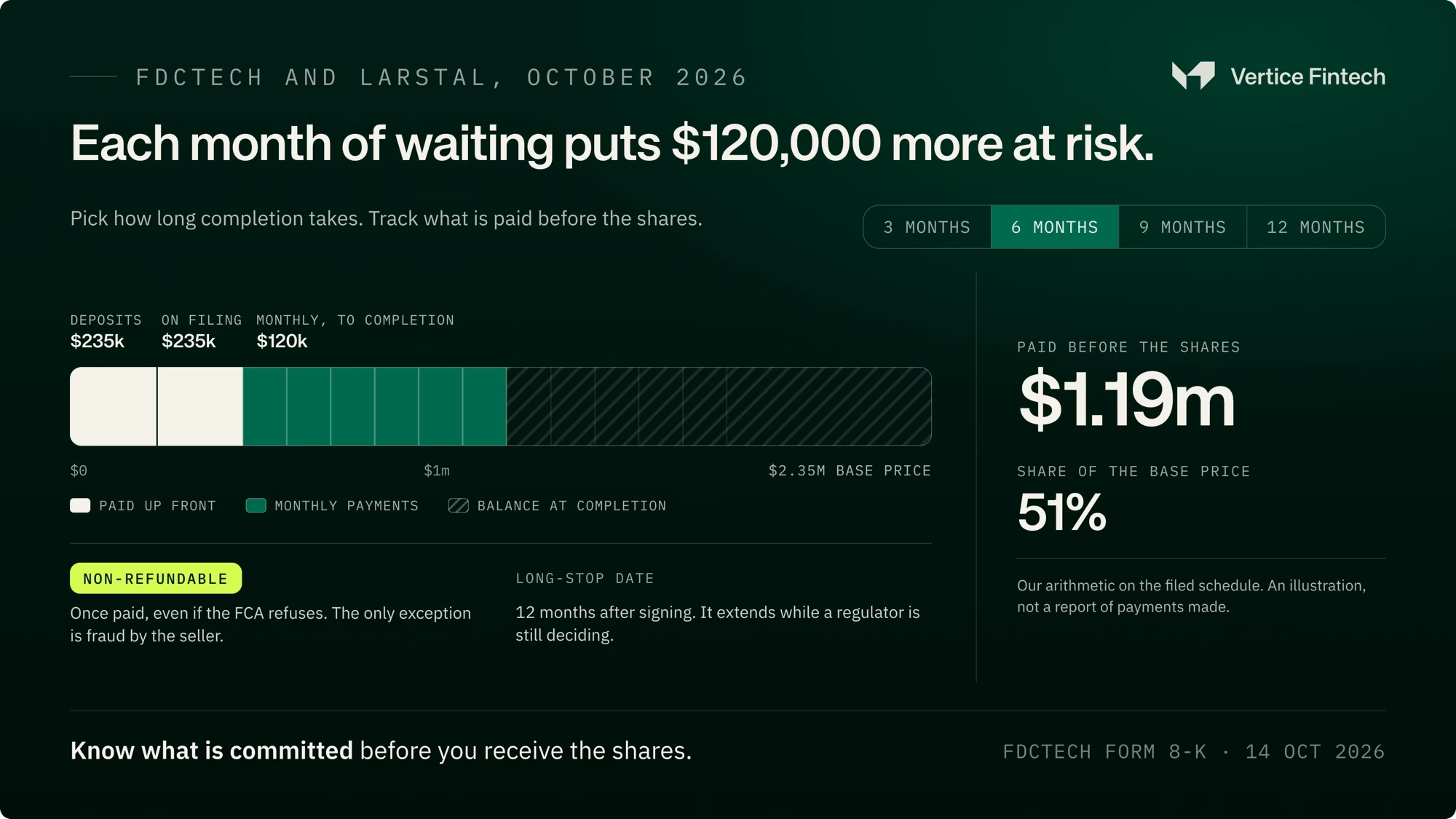
- $235,000 in deposits (across both companies), paid under a term sheet in August and released to the sellers at signing
- a further $235,000 when the change-in-control applications are filed
- $60,000 a month for each company, so $120,000 a month in total, until completion
These payments count towards the price. But they are non-refundable once paid, even if the FCA refuses the deal. The only exception is fraud by the seller. The filing itself lists the risk “that delays in completion increase the interim payments”.
Here is an illustration, not a report of what has been paid. Say both filing payments are made, and six monthly payments fall due before completion. The buyer would then have paid about $1.19 million before receiving the shares ($235,000 + $235,000 + 6 × $120,000).
Three more terms matter for timing:
- FCA approval cannot be waived. The UK deal cannot complete without it.
- The long-stop date is 12 months after signing. It extends automatically while a regulator is still considering the application, unless the buyer caused the delay. This is a contract protection, not a forecast of how long the FCA will take.
- The buyer’s own group is under review. The filing discloses a skilled person review at one of the buyer’s subsidiaries. This is an independent review the FCA can order under section 166 of FSMA. It began on 24 October 2025 and is still ongoing. The filing says the FCA may consider the group’s regulatory history, and that the buyer “cannot predict” the effect on the outcome or timing.
The lesson for buyers: know how much money is committed before you receive the shares, and what happens if the deal fails. The lesson for sellers: certainty of completion can matter as much as the headline price. Our guide on moving from agreed price to completed deal covers how to structure for this.
Payward and Saldo: approval sets the timetable
On 14 October 2026, Payward, the company behind crypto exchange Kraken, announced an agreement to buy Saldo, owner of a bank licensed in Lithuania[12]. It expects the deal to close in 2027, subject to regulatory approvals.
This is a bank, not a UK payment institution, so it is not a benchmark. The point is simpler. Even a well-funded buyer sets its closing date around regulatory approval.
The FCA decides on a new owner in weeks. A new licence takes months.
On the FCA’s latest figures, for April to June 2026, the median decision took 43 days for a change in control and 219 days for a new payment or e-money firm. Three quarters of change-in-control decisions came within 71 days. Three quarters of new applications took 168 days or more. These are FCA decision times only, for different groups of firms. The whole project adds preparation, due diligence and negotiation.
Buying can give you a firm that already trades, with its customers and contracts, and also its history. Applying gives you a clean start, but you build everything yourself.
Here is what the FCA’s figures for April to June 2026 show:
| Route | FCA decision time | Legal deadline |
|---|---|---|
| New payment or e-money firm application | Median 219 days; a quarter took 268 days or more | 3 months from a complete application; 12 months in any case[13] |
| Change in control | Median 43 calendar days; three quarters within 71 | 60 working days from a complete notice, plus one pause |
The two figures cover different groups of firms, so this is not a direct comparison. The FCA also reported that payment and e-money applications missed its service target in that quarter. And neither figure covers the whole project. A purchase also needs a target, due diligence and negotiation. An application also needs a business plan, policies and capital. Either route can fail.
On 14 October 2026, Pliant announced that its UK subsidiary had received full FCA authorisation as an EMI[14]. It did not say how long the application took. That is the number a buyer weighing the two routes would most like to know, and it is rarely published.
The real question is not “which is faster”. It is “when can this business offer the services I need, with the right permissions, funding and partners”. An active firm with clean records can bring customers, banks and payment routes. A dormant or restricted firm may not, and its contracts may not fit the buyer’s plans. Compare both routes for the specific target. Our SPI vs API vs EMI guide covers what each licence gives a buyer.
Does the timeline differ for an SPI, an API or an EMI?
The FCA change-in-control process is the same for all three. The same 60-working-day clock, the same single pause and the same six tests apply.
The differences come from the business behind the licence:
- SPI. Often a smaller business with fewer contracts. Due diligence can be quicker. But SPIs may keep simpler records, which can slow it down. Check that the firm has stayed under its volume limit.
- API. More permissions, more volume and stricter safeguarding rules. There is more to check, especially safeguarding and capital.
- EMI. The highest minimum initial capital of the three (€350,000 for an authorised EMI), plus e-money activities to check. Small EMIs have different rules. Groups with EMIs in several countries, as in the FDCTech deal, need each country’s regulator.
The licence type tells you what to check. It does not rank deals from fastest to slowest. The actual business decides the work. In every case, cleaner records mean fewer questions.
How to shorten the timeline
Many delays can be reduced. They often come from missing documents, late questions and parties approached too late.
For buyers
- Prepare your own change-in-control file before you sign. Ownership chain, source of funds, business plan and the CVs of the people who will run the firm. The clock cannot start until it is complete.
- Check your own regulatory record. The FCA can consider open reviews anywhere in your group.
- Read the bank and partner contracts early. Find every change-of-control clause in the first week of due diligence.
- Set a realistic long-stop date. Base it on the full assessment period and pause, not the median, and leave room for banks and partners.
- Model the cost of waiting. If the deal includes payments before completion, know how much is at risk if it fails.
For sellers
- Build the data room before you go to market. A data room is the folder of documents the buyer will check. Accounts, safeguarding records, FCA correspondence and contracts first.
- Deal with open FCA questions, and disclose them. An open matter can affect the price or the terms. Disclosed early, it can be priced in rather than found late.
- Talk to your bank before you sign. Know what it will ask a new owner for.
- Judge offers on certainty, not only price. A buyer with a complete FCA file and clean funding may complete with more certainty.
For both sides
Run the stages in parallel where you can. Due diligence, the sale agreement and the buyer’s FCA file can progress at the same time. The FCA notice can go in once the buyer has decided to buy. The FCA says to notify once you have made that decision[8].
What could change the timeline in 2026 and 2027?
Three developments are worth watching. None has changed the rules yet.
- Payment system access disputes. The PSR’s proposal in CP26/3 would update its indicative timelines for access applications. It closes on 10 December 2026.
- National security sectors. In March 2026 the government confirmed changes to the compulsory sectors, including adding water and splitting out critical minerals and semiconductors[15]. Payments is not named. The changes need new regulations, which the government said it intends to lay later this year. No start date is set.
- Payments regulation reform. HM Treasury’s consultation on modernising the UK’s payment rules ran from 14 July to 6 October 2026[16]. The law has not changed yet. Buyers should check how any new rules would treat the permission they are buying.
As of 21 October 2026, the FCA’s figures for July to September 2026 are not yet published. Check them before you set a timetable.
Frequently asked questions
How long does it take to buy a UK payment institution?
There is no reliable published average for the whole purchase. FCA change-in-control decisions took a median of 43 calendar days from receipt in April to June 2026, across all FCA-only regulated firms. Preparation, due diligence, negotiation and bank consents come on top. They depend heavily on the seller’s records and the buyer’s FCA file.
How long does FCA change-in-control approval take?
Half of all decisions took 43 calendar days or less in April to June 2026, and three quarters took 71 or less. The legal assessment period is 60 working days from a complete notice. The FCA can pause once, for up to 30 working days, or 20 if the buyer is a UK bank, insurer, investment firm or UCITS fund manager.
When does the FCA’s 60-day clock start?
The clock starts on the day the FCA acknowledges a complete section 178 notice. It does not start when you send it. If documents are missing, the notice waits outside the clock until the gaps are filled. This is why a complete notice on day one matters.
Do I need FCA approval to buy an SPI?
Yes. The FCA’s change-in-control rules apply to small payment institutions as well as authorised payment institutions and e-money firms. A buyer must get FCA approval before taking control. Completing without approval is a criminal offence. The lighter SPI registration does not mean a lighter sale process.
Is it quicker to buy a payment institution or apply for a new licence?
At the FCA stage, yes. In April to June 2026, the FCA took a median of 43 days to decide a change in control and 219 days to decide a new payment or e-money application. The two cover different groups of firms and leave out preparation. Buying can also give you a firm that already trades, if the target is active.
What slows down the purchase of a payment institution most?
No published data ranks the causes. Three common ones are avoidable. An incomplete FCA notice does not start the clock. Gaps in the seller’s records slow due diligence. Bank and partner consents asked for too late can hold up completion. Starting all three early reduces the risk.
Can the deal complete before the FCA approves it?
No. The buyer cannot take control until the FCA approves it, and doing so is a criminal offence. Buyers and sellers can sign the sale agreement first, with completion conditional on FCA approval. A long-stop date sets how long either side will wait.
What is a long-stop date in a payment institution sale?
A long-stop date is the last date by which the deal must complete. After it, either side can usually walk away. In a deal agreed on 6 October 2026, the long-stop date was 12 months after signing, extended automatically while a regulator was still deciding.
Does a foreign buyer take longer to get FCA approval?
It can. A buyer based or regulated outside the UK gets the longer pause of up to 30 working days. So does any UK buyer that is not a bank, insurer, investment firm or UCITS fund manager. Foreign buyers often have longer ownership chains, which take more time to explain. A deal may need approval in other countries too. Some may need a national security review.
Does a bank have to agree when a payment institution is sold?
There is no general FCA rule that a bank must consent. But bank contracts may require notice, consent or a review when the owner changes. A bank that will not accept the new owner can delay completion. Check each contract early and speak to the bank before signing.
The short version
- The FCA stage has a set timetable. Half of decisions took 43 days or less. The assessment period, with its one pause, is up to about 18 weeks from a complete notice.
- Most stages before and after the FCA have no legal deadline. They depend on how ready both sides are.
- A complete FCA notice on day one is the fastest route. The clock does not start until it is complete.
- Banks, partners and other regulators set their own pace. Ask them early.
- Waiting can cost money. In one October deal, six months of waiting would mean about $1.19 million paid before completion, non-refundable except for seller fraud.
Vertice Fintech has been brokering payment firms since 2010, including 23 acquisitions in 2025. We plan every deal around the clocks that actually decide completion. If you are buying or selling an SPI, an API or an EMI and want a realistic timetable, talk to Vertice Fintech. You can also view the marketplace.
This article is general information, not legal or regulatory advice. Deadlines and figures are correct as of 21 October 2026.
Sources and references
- FCA safeguarding requirements for payment and e-money firms
- FCA Authorisations operating service metrics, Q1 2026/27
- Financial Services and Markets Act 2000 section 189
- Financial Services and Markets Act 2000 section 190
- Financial Services and Markets Act 2000 section 186
- Payment Services Regulations 2017 Schedule 6
- Electronic Money Regulations 2011 Schedule 3
- FCA Change in control
- Payment Systems Regulator CP26/3: Regulatory framework for access to payment systems
- GOV.UK National Security and Investment Act: guidance on acquisitions
- FDCTech, Inc. Form 8-K
- Payward press release on the Saldo acquisition
- Payment Services Regulations 2017 regulation 9
- Pliant press release on its UK EMI authorisation
- GOV.UK government response on the NSI notifiable acquisition regulations
- HM Treasury Modernising Payment Services Regulation consultation
- Payment Systems Regulator, CP26/3 consultation paper (PDF), paragraphs 2.48 to 2.50