
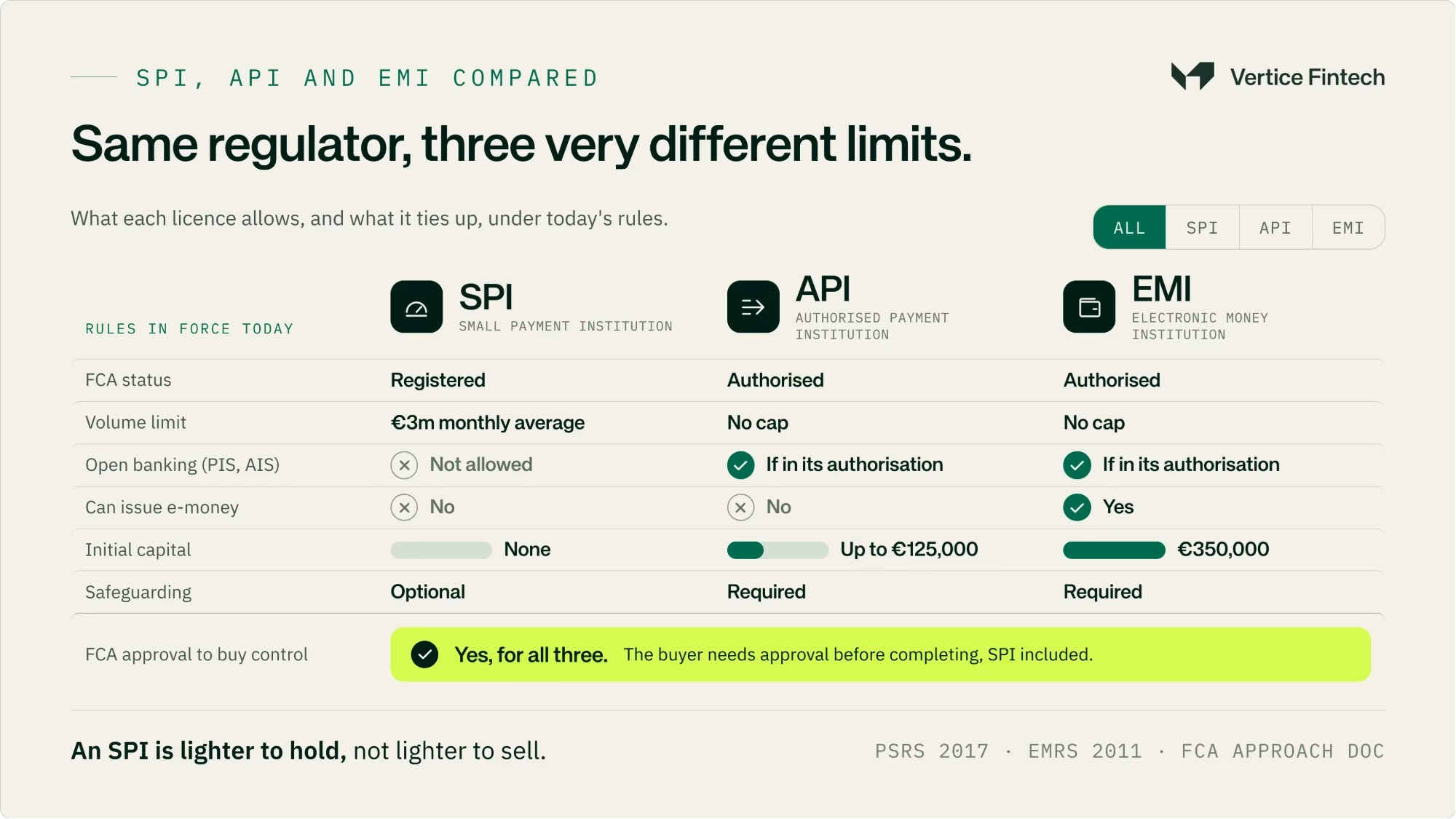
An SPI needs no regulatory capital, but it is the most limited. An API carries more volume and more services. An EMI can issue e-money and has the highest minimum capital. Here is what each one gives a buyer, and what that does to the price.
The licence type sets what a buyer can do on day one, how far the business can grow, and how much money stays locked inside it. That is why buyers pay different prices for an SPI, an API and an EMI, even when the businesses look alike.
This guide compares SPI vs API vs EMI from the buyer’s side of the table. It covers what each licence allows, what it ties up, and what must happen before it changes hands. It does not quote prices, because each deal is priced on the business behind the licence.
There is also a new question this month. HM Treasury’s consultation on rewriting the UK’s payment rules closed on 6 October 2026. On the same day, the Electronic Money Association (EMA) asked the government to keep the small-institution regime in law and to carry existing permissions across without re-authorisation. Nothing has changed yet. A buyer now has one more thing to check: will this permission move cleanly into the new rules?
The short answer
- SPI (small payment institution). Registered with the FCA, not authorised. No capital requirement. Capped at a €3 million monthly average of payment transactions over 12 months. Cannot offer open banking services. Suits a buyer with a focused UK payments business below the cap.
- API (authorised payment institution). Fully authorised. No volume cap. Can hold open banking permissions. Needs up to €125,000 of initial capital, depending on its services, keeps own funds at all times, and must safeguard the customer money it holds.
- EMI (electronic money institution). Can issue e-money, the stored value behind wallets and prepaid cards. Needs €350,000 of initial capital and must safeguard customer money. Can also provide payment services without a separate authorisation.
All three need FCA approval before a buyer takes control. That includes the SPI.
What is the difference between an SPI, an API and an EMI?
An SPI is a small payment firm registered with the FCA under a volume cap. An API is a payment firm fully authorised by the FCA, with no volume cap. An EMI is authorised to issue electronic money, the stored value behind wallets and prepaid cards, and it can provide payment services too.
SPIs and APIs sit under the Payment Services Regulations 2017 (the PSRs). EMIs sit under the Electronic Money Regulations 2011 (the EMRs). The Financial Conduct Authority (FCA) supervises all three.
| SPI | API | EMI | |
|---|---|---|---|
| FCA status | Registered | Authorised | Authorised |
| Volume limit | €3m monthly average over 12 months | No cap | No cap |
| Open banking (PIS and AIS) | Not allowed | Allowed, if in its authorisation | Allowed, if in its authorisation |
| Can issue e-money | No | No | Yes |
| Initial capital | None | Up to €125,000, by service | €350,000 |
| Ongoing capital | None | Own funds at all times | Own funds at all times, including 2% of average outstanding e-money |
| Safeguarding customer money | Optional | Required | Required |
| FCA approval needed to buy control | Yes | Yes | Yes |
The regulations set these amounts in euros, not pounds. Two terms in the table need a plain definition. Payment initiation (PIS) means starting a payment from a customer’s bank account. Account information (AIS) means reading a customer’s bank account data, with their consent.
Two smaller variants also exist. A small EMI is registered rather than authorised and is capped at €5 million of average outstanding e-money. A registered account information service provider (RAISP) can only offer account information services.
Table sources: PSRs reg 14, reg 22, reg 23 and Schedule 3; EMRs reg 13, reg 19 and Schedule 2; FCA Approach Document, paragraphs 3.4 to 3.6 and 4.21.
What is a buyer actually buying?
This guide is about buying control of the company that holds the registration or authorisation. The permission belongs to that company. If the business moves into a different legal entity, the firm must apply to the FCA first, and the FCA cancels the old permission and registers or authorises the new entity [10].
So buying a licence really means buying a company, with its customers, contracts, history and obligations.
How do buyers decide what a licence is worth?
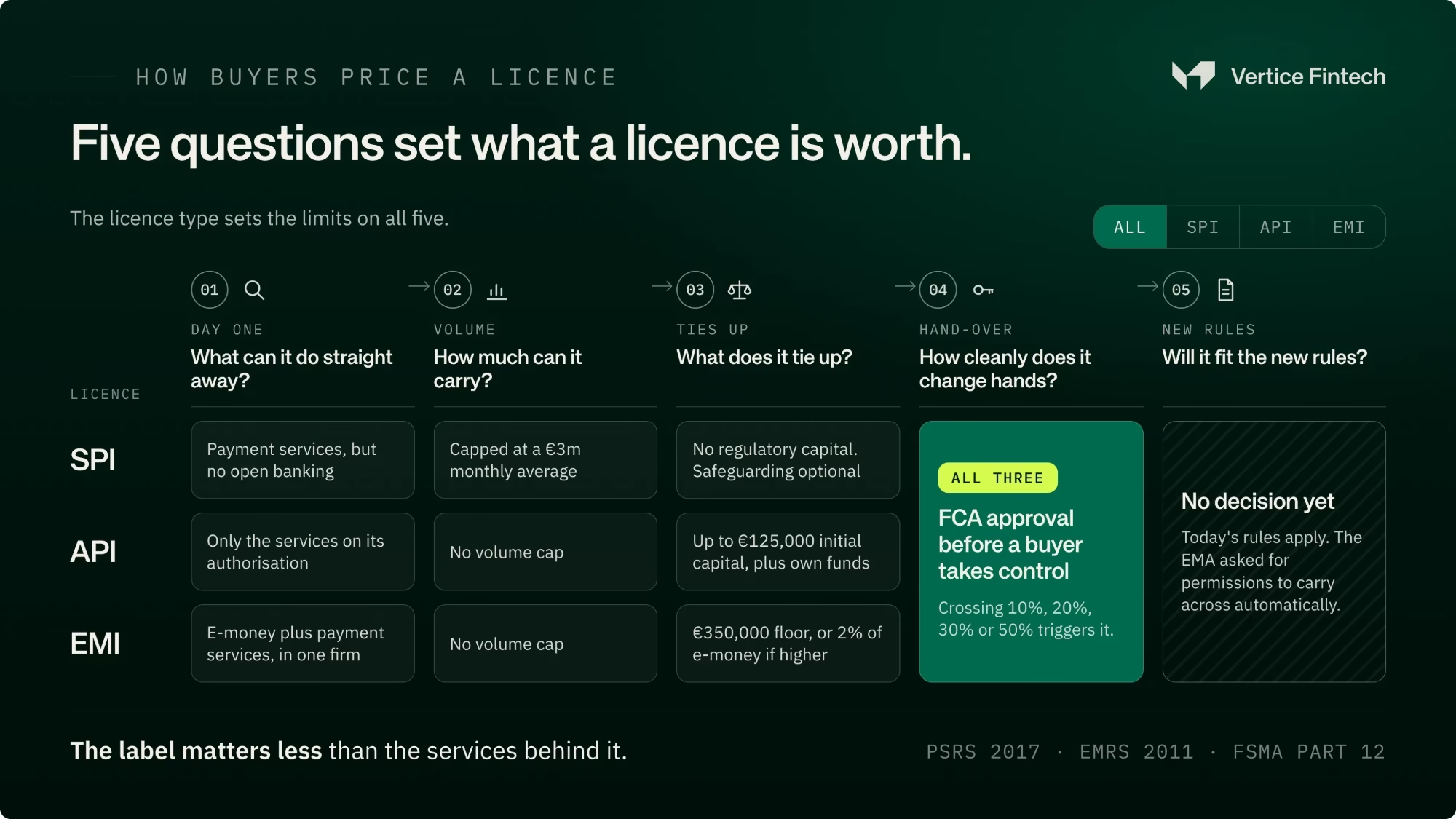
Buyers price a licence on five questions. What can I do with it on day one? How much volume can it carry? What does it tie up? How cleanly does it change hands? Will it fit the new rules? The licence type sets the limits on all five.
1. What can the buyer do with it on day one?
A buyer pays for permissions it can use straight away. The label on the licence matters less than the list of services behind it.
The FCA Register shows that list. By law, the register must identify the payment services each institution is authorised or registered for [11].
Two APIs can be worth very different amounts to the same buyer. One may hold money remittance only. Another may hold payment accounts, card acquiring and open banking. An SPI can never hold open banking permissions, whatever its size [1].
2. How much volume can it carry?
Headroom is the gap between today’s volume and the cap. For an SPI, the cap is a €3 million monthly average over 12 months. It applies at registration and for as long as the firm stays an SPI [12].
The test counts the value of payment transactions, including those made through UK agents. It does not count revenue or profit [1]. Because it is an average over any 12 months, one large month does not break it on its own.
Take an SPI averaging €2.4 million a month. It has €0.6 million of headroom. That is 20% of the cap, or room to grow 25% on today’s average. A buyer planning to add clients looks at that number first.
The cap is in euros, so a UK SPI that trades in pounds has to convert its figures. The FCA says it is reasonable to convert monthly turnover using the European Commission’s monthly accounting rate for the euro [8]. So the headroom moves with the exchange rate.
Two illustrative rates show how. If €1 buys £0.85, the cap is about £2.55 million a month. If €1 buys £0.88, it is about £2.64 million. These are examples, not today’s rate.
APIs and EMIs have no volume cap. Their capital requirement can grow with the business instead.
3. What does it tie up, and what does it cost to run?
Keep three things apart: the price paid to the seller, the capital the firm must hold, and the customer money it safeguards.
- Capital is the firm’s own financial buffer, not a fee. It stays in the company. A buyer checks what the firm already holds against what the rules and the buyer’s plan require. If the firm already holds enough, the buyer does not have to put the minimum in again.
- Safeguarded money belongs to customers. It is not part of the price, and it cannot fund the seller’s payout or the buyer’s growth [3].
- Running costs sit on top, such as safeguarding records and checks, and insurance where it is required.
The capital rules for each licence:
- SPI: no initial or ongoing capital requirement [8]. Safeguarding is optional.
- API: initial capital of €20,000 for money remittance only, €50,000 for payment initiation, and €125,000 for services such as payment accounts, card issuing or merchant acquiring. Account information alone needs none. Where a firm offers several services, the highest amount applies [4]. After that, own funds must stay at or above the higher of that amount or a calculated figure [2]. A firm offering only payment initiation or account information skips the calculation. Any API offering either service also needs professional indemnity insurance or a comparable guarantee [13].
- EMI: own funds of at least €350,000 at all times, or the calculated requirement if that is higher. For e-money, the calculation is 2% of average outstanding e-money. Unrelated payment services add to it, and the FCA can direct an adjustment [6][7].
Safeguarding means protecting customer money, usually by keeping it separate from the firm’s own money. The FCA’s new safeguarding rules took effect on 7 May 2026. They apply to APIs (except firms that only offer payment initiation or account information), authorised EMIs and small EMIs. An SPI can opt in, and then the same rules apply [14].
For a buyer, a clean safeguarding record is part of what it pays for. A gap gives the buyer a reason to lower the price, and may need fixing or funding before completion.
4. How cleanly does it change hands?
All three licences need FCA approval before a buyer takes control. The rules come from Part 12 of the Financial Services and Markets Act 2000 (FSMA). They apply to SPIs as well as APIs and EMIs [15][8].
- The trigger: crossing 10%, 20%, 30% or 50% of the shares or voting power, or gaining significant influence over the firm.
- The order: the buyer notifies the FCA and gets approval before completing.
- The clock: the FCA has 60 working days from a complete notification and can pause the clock to ask questions. That is the FCA’s assessment period, not the whole deal timetable.
- The risk: completing without approval is a criminal offence [16].
- The seller’s duty: a seller must give the FCA written notice before reducing or giving up control [8].
The buyer’s own file sets much of the pace. A buyer taking more than 50% must send a business plan, and the FCA treats the notification as incomplete until an adequate plan arrives [16]. Our guide to FCA change of control covers the process in full.
5. Will the permission fit the new rules?
HM Treasury is considering moving some requirements in the PSRs and EMRs into FCA rules, and asked which should stay in law [17]. The consultation closed on 6 October 2026. The EMA’s response, dated the same day, asked for today’s permissions to move across automatically. It said it is “strongly opposed to any requirement for re-authorisation” [9].
No decision has been made, and today’s rules still apply. A buyer can still ask the seller a direct question: which permissions does the firm hold, and which does it use? In our view, a permission in active use is easier to price than one that exists only on the register.
What is an SPI worth to a buyer?
An SPI is worth most to a buyer that needs a UK payments business averaging below €3 million a month, with no open banking. It needs no regulatory capital. Its value falls quickly when the buyer’s plan needs more volume or more services, because growing past the cap means a new authorisation.
Where an SPI fits
An SPI suits focused businesses, such as a money remittance corridor or a small business-to-business payments service. SPIs, like APIs, can also offer foreign exchange services closely linked to their payments [18].
The SPI itself must keep its head office, registered office or place of residence in the UK [1]. An overseas buyer can own an SPI, but the SPI’s UK base has to stay.
What happens when an SPI outgrows the cap?
If its volume passes the cap, the SPI must apply for authorisation within 30 days of becoming aware, if it wants to keep providing payment services in the UK [19]. The FCA expects a full API application, plus a form cancelling the SPI registration [8]. It is a new application, not a quick change.
The FCA’s own figures show the time involved. Between April and June 2026, the median application to become a payment or e-money firm took 219 days from arrival to decision. One in four took 268 days or more [20]. The clock starts when the FCA receives the application, so the time spent preparing it comes on top.
A buyer who plans to grow past the cap is really buying two things: a live SPI today, and an authorisation project tomorrow. Price both.
What buyers check in an SPI
- Twelve months of monthly payment volume, converted to euros the way the FCA describes.
- Whether the firm safeguards customer money by choice, and how.
- Whether its services match the buyer’s plan, given that open banking is ruled out.
- That the UK base can stay in place after the sale.
What is an API worth to a buyer?
An API is worth most to a buyer that needs volume, a wider set of services, or open banking. It costs more to hold than an SPI. Its value depends on the exact payment services in its authorisation, and on how much of that scope the business actually uses.
The scope is the asset
An API’s authorisation lists specific payment services. A buyer that needs card acquiring gains little from an API authorised only for money remittance. The FCA Register is the first place to check, before any price discussion.
Scope also sets capital. An API that adds payment accounts or acquiring moves from the €20,000 money remittance level to the €125,000 level [4].
Open banking permissions can earn outside payments
SPIs cannot hold payment initiation or account information permissions. APIs and EMIs can, and a RAISP can hold account information on its own. These permissions can create income beyond moving money.
Ecospend is one public example. Trustly, a Swedish payments company, announced its purchase of Ecospend in May 2022 and completed it in January 2023, after FCA approval. At completion, Trustly described Ecospend as authorised by the FCA for payment initiation and account information [21].
In August 2026, the Government Digital Service awarded Ecospend a £4.7 million contract. The work supports identity verification, identity validation and fraud risk assessment for GOV.UK One Login, and runs to February 2029 [22]. That is open banking used for identity checks, not payments.
There is a possible cost to watch too. HM Treasury says it is committed to protecting fintechs that rely on free access today. It also intends to let the FCA decide whether some open banking access that banks and other account providers give free could, in future, become paid [17]. Nothing has been decided. For an API whose income depends on that access, it is a line to keep in the cost model.
What buyers check in an API
- The exact payment services on the FCA Register, and which ones the business uses.
- Own funds today against the requirement, and against the buyer’s growth plan.
- Safeguarding method and records under the new FCA rules.
- Any business that depends on open banking access, and what that access costs.
What is an EMI worth to a buyer?
An EMI is worth most to a buyer that needs to issue e-money, the stored value behind wallets and prepaid cards. It has the highest minimum capital of the three. It can also provide payment services, so a buyer gets both in one firm [8].
A payment institution can hold customer money too, but only for payment transactions. The FCA says those funds cannot be held indefinitely, and offering savings would breach the rules [23]. Holding stored value for customers to spend later is what e-money is for.
The capital cost
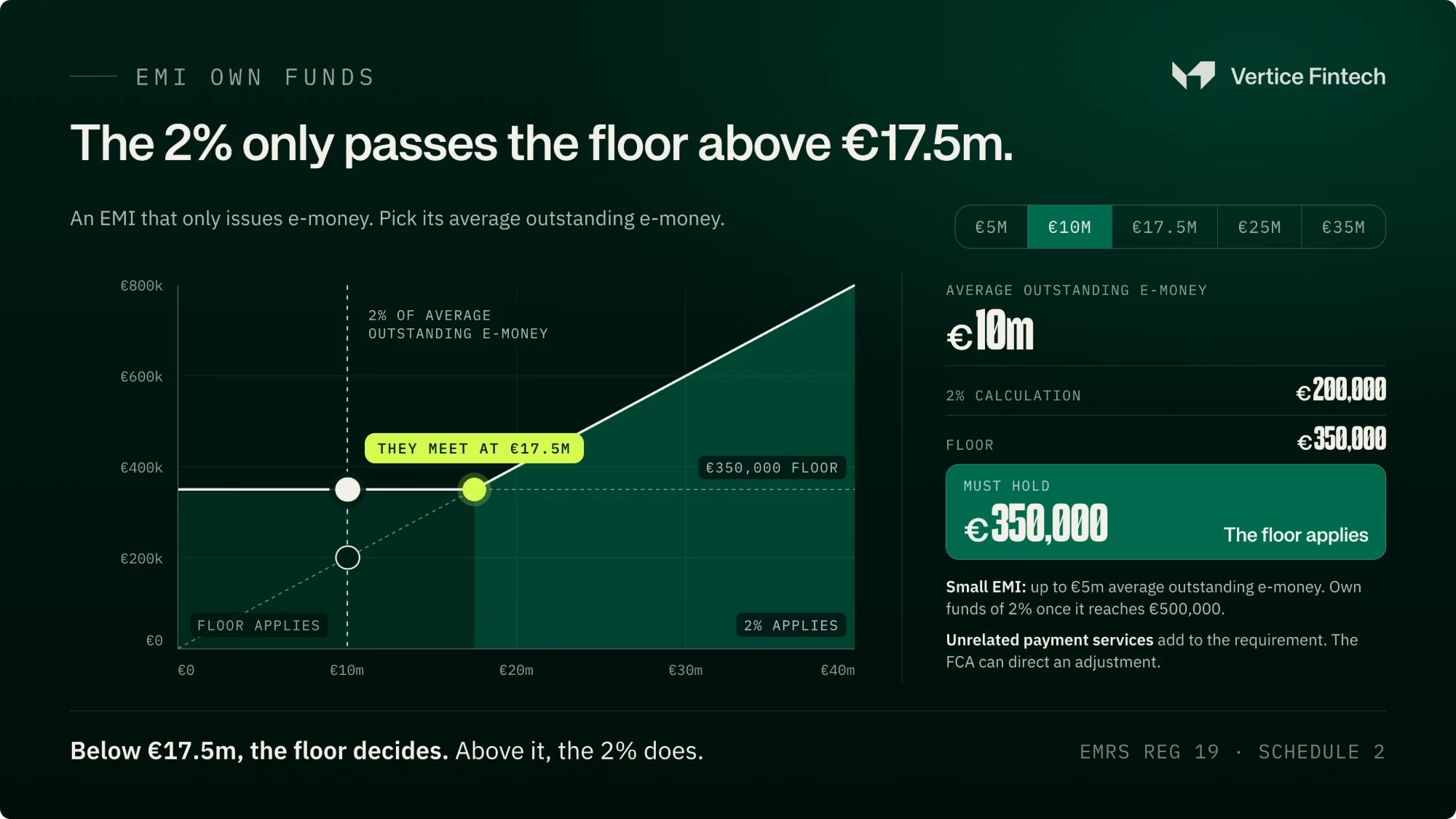
An authorised EMI must hold own funds of at least €350,000 at all times. If its calculated requirement is higher, that figure applies instead [6].
For e-money, the calculation is 2% of average outstanding e-money. Take an EMI that only issues e-money and holds €10 million on average. Two per cent is €200,000, which is below the floor, so it must hold €350,000. The 2% figure only passes the floor above €17.5 million of average outstanding e-money.
Small EMIs
A small EMI is registered rather than authorised. Its average outstanding e-money must not exceed €5 million. Payments unrelated to its e-money must not exceed a €3 million monthly average, and it cannot offer open banking services [5]. Once its average outstanding e-money reaches €500,000, it must hold own funds of 2% of that amount [6].
A payment institution cannot simply add e-money
A business that wants to issue e-money must become an authorised EMI or a small EMI [8]. A buyer with a wallet product in its plan should buy an EMI, or price in a new application.
What buyers check in an EMI
- Average outstanding e-money over time, and the capital it requires.
- How customer funds are safeguarded, and the records behind it.
- Whether the payment services the buyer needs are in the authorisation.
Which licence should a buyer choose?
Choose the licence that fits the business plan for the next two to three years, not the cheapest one today. A low price for an SPI is poor value if the plan breaks the cap in year one.
| If the buyer’s plan needs | The best fit is usually |
|---|---|
| UK payments averaging below €3 million a month, no open banking | SPI |
| Average volume above €3 million a month, or fast growth | API |
| Payment initiation or account information | API, or an EMI with those permissions |
| Account information only | RAISP |
| Issuing e-money, such as wallets or prepaid cards | EMI (or a small EMI below €5 million outstanding) |
The FCA decides on a new owner in weeks. A new licence takes months.
At the FCA stage, buying is quicker. Here is what the FCA’s figures show.
- New payment or e-money firms, April to June 2026: median of 219 calendar days from the FCA receiving the application to its decision.
- Change-in-control decisions for firms regulated only by the FCA, same period: median of 43 calendar days from the FCA receiving the notification to its decision.
The two figures cover different groups of firms, so they are not a direct comparison [20]. Neither covers the whole project: finding a target, due diligence and negotiation on one side, or preparing an application on the other. An application can be refused, and a purchase can fall through. Compare the full cost and time of both routes. What buying can add, if the target is active, is a firm that already trades, with a record the buyer can check. Our article on what buyers actually pay for goes further on buy versus build.
For the full purchase, stage by stage, see our guide on how long it takes to buy a UK payment institution.
Does FCA change in control apply when buying an SPI?
Yes. The FSMA change-in-control rules apply to SPIs as well as to APIs and EMIs. A buyer of an SPI needs FCA approval before taking control, on the same 10%, 20%, 30% and 50% thresholds [15][8].
It is easy to assume that a lighter registration means a lighter sale process. It does not. The buyer’s timetable should include the FCA assessment whichever licence it buys. Our guide from agreed price to completed deal sets out what has to happen between signing and completion.
What could payments reform change for each licence?
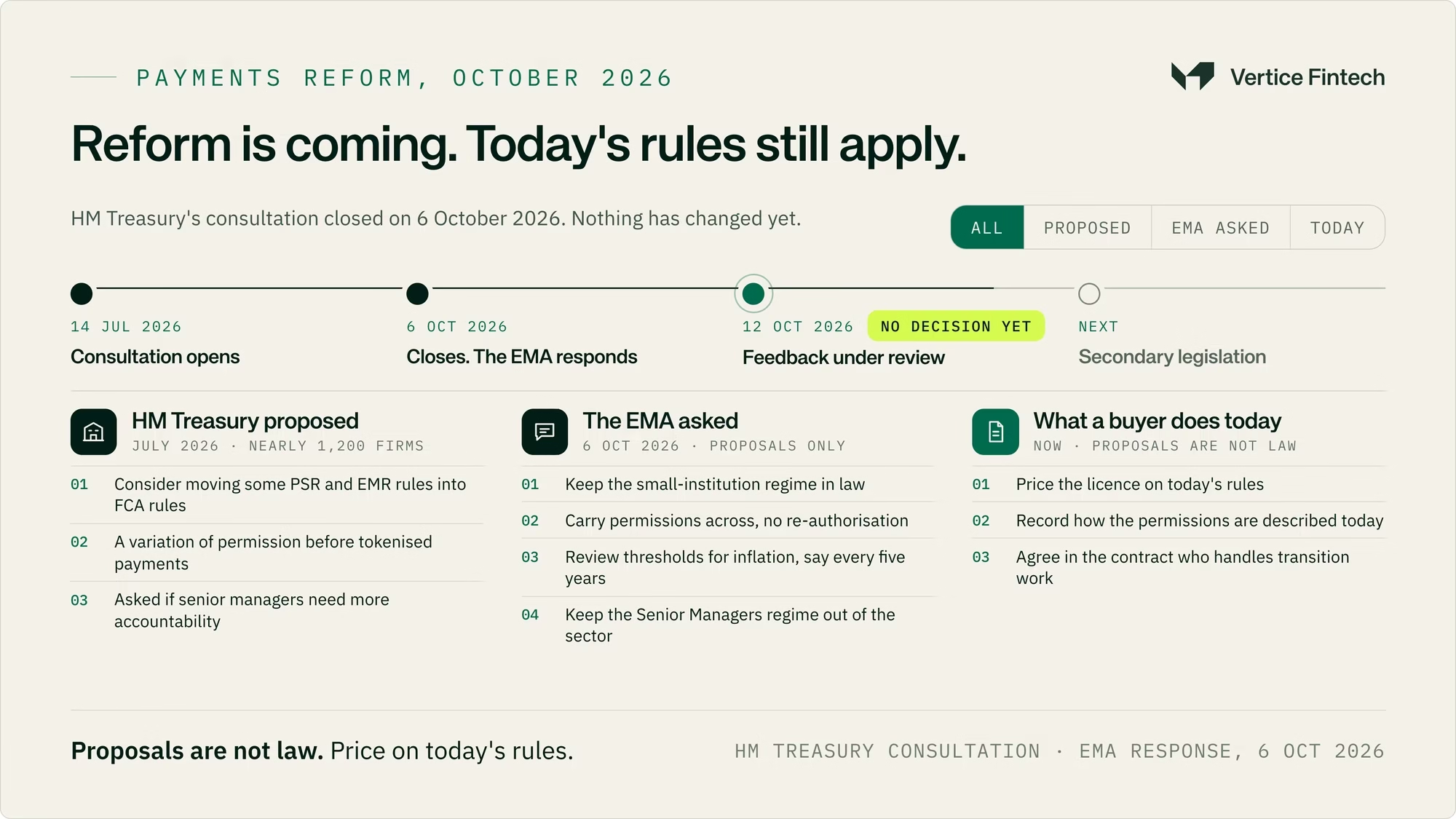
Nothing yet. The rules in force today still apply. HM Treasury’s consultation closed on 6 October 2026, and the government is analysing the feedback [24]. It has said changes will come through secondary legislation, with detail on how after the consultation.
What HM Treasury proposed in July
- Consider moving some requirements in the PSRs and EMRs into FCA rules, while keeping essential ones in law.
- Require firms that are already authorised or registered to get a variation of permission before offering tokenised payments, meaning payments made with digital tokens.
- Ask whether senior managers of payment and e-money firms should carry more personal accountability.
Nearly 1,200 firms are authorised or registered under the PSRs and EMRs. The proposals cover all of them [17].
What the EMA asked for on 6 October
The EMA represents e-money and payment firms. Its response asked the government to:
- keep the small-institution regime, the basis for SPIs and small EMIs, in legislation (page 4);
- move existing permissions across automatically, without re-authorisation (page 21);
- review money thresholds in the PSRs and EMRs against inflation, for example every five years, because they date from older EU rules (pages 13 to 14);
- avoid extending the Senior Managers and Certification Regime to the sector (page 29).
These are industry proposals, not decisions. The EMA did not propose a specific new figure for the SPI cap. [9]
What it means for a buyer today
- Price the licence on today’s rules. Proposals are not law.
- Record exactly how the firm’s permissions are described today. Any transfer to new rules would start from that list.
- Agree in the sale contract who handles any transition work if the rules change before completion.
What should a buyer check before making an offer?
Seven checks cover most of what decides the price of an SPI, API or EMI.
- FCA Register entry. Registered or authorised, the exact payment services, and any restrictions.
- Volume. Twelve months of monthly figures, in euros, against any cap.
- Capital. Own funds today against the requirement, for APIs and EMIs.
- Safeguarding. The method, the records, and whether the new FCA rules apply.
- Controllers. Who will cross which threshold, and what the FCA will need from each of them.
- Fit. Any permission the buyer’s plan needs that the firm does not hold.
- Contracts. Banking, safeguarding and supplier agreements, and any terms triggered by a change of owner. FCA approval does not give those consents.
A firm that has gone quiet needs extra care. The FCA can cancel a payment institution’s authorisation or registration if the firm stops doing business for more than six months, or does not start within 12 months [25]. Our article on dormant SPI and API licences explains what that does to a deal.
Frequently asked questions
What is the difference between an SPI and an API?
An SPI is registered with the FCA and limited to a €3 million monthly average of payment transactions. It cannot offer payment initiation or account information services, and it has no capital requirement. An API is fully authorised, has no volume cap, can hold open banking permissions, needs initial capital of up to €125,000 depending on its services, and must safeguard the customer money it holds.
Is an SPI a licence?
Not strictly. An SPI is registered with the FCA, while an API or EMI is authorised. Registration is cheaper and simpler and carries no capital requirement. In practice, buyers and sellers still call it a licence, because it is the permission that lets the firm provide payment services in the UK.
What happens when an SPI goes over the €3 million limit?
If its monthly average of payment transactions over 12 months passes €3 million, it must apply for authorisation as an API within 30 days of becoming aware, if it wants to keep providing payment services in the UK. The FCA expects a full API application and a form cancelling the SPI registration. This is a new application, and FCA data for April to June 2026 shows a median of 219 days from receipt to decision.
Can an SPI offer open banking services?
No. The Payment Services Regulations bar an SPI from providing payment initiation services or account information services. A buyer that needs either should look at an API with those services in its authorisation, or an EMI. A firm that only needs account information can register as a registered account information service provider instead.
How much capital does an API need?
It depends on the services. Money remittance alone needs €20,000 of initial capital, payment initiation needs €50,000, and services such as payment accounts, card issuing or acquiring need €125,000. Account information alone needs none. After authorisation, the API must keep own funds at or above the higher of that amount or a calculated figure.
How much capital does an EMI need?
An authorised EMI must hold own funds of at least €350,000 at all times, or its calculated requirement if that is higher. For e-money, the calculation is 2% of average outstanding e-money, and unrelated payment services add to it. A small EMI needs own funds of 2% of average outstanding e-money once that reaches €500,000.
Does buying an SPI need FCA change-in-control approval?
Yes. The change-in-control rules in Part 12 of FSMA apply to SPIs, APIs and EMIs. A buyer crossing 10%, 20%, 30% or 50%, or gaining significant influence, must notify the FCA and get approval before completing. Completing without approval is a criminal offence.
Can a payment institution issue e-money?
No. A business that wants to issue e-money must become an authorised EMI or a small EMI. An EMI, by contrast, can provide payment services without a separate authorisation under the Payment Services Regulations. A buyer with a wallet or stored-value product in its plan should buy an EMI or budget for a new application.
Is it quicker to buy a payment institution or apply for a new one?
At the FCA stage, yes. FCA data for April to June 2026 shows a median of 43 calendar days to decide a change in control and 219 days to decide a new payment or e-money firm application. These cover different groups of firms and exclude preparation, and either route can fail.
Will payments reform change SPI, API or EMI permissions?
Not yet. HM Treasury’s consultation closed on 6 October 2026, and changes would come through secondary legislation. The Electronic Money Association has asked for existing permissions to move across automatically, without re-authorisation, and for the small-institution regime to stay in law. Until the government decides, today’s rules apply.
The short version
- An SPI needs no regulatory capital, but is capped at a €3 million monthly average, with no open banking.
- An API needs capital and safeguarding, but has no volume cap and can carry the full range of payment services.
- An EMI has the highest minimum capital, and can issue e-money and provide payment services in one firm.
- All three need FCA approval before a buyer takes control.
Vertice Fintech brokers SPI and API sales and acquisitions in the UK. To talk through a specific purchase, speak to Rodolfo Basilio. To see firms currently for sale, browse the marketplace.
This guide summarises the rules as checked on 12 October 2026. It is general information, not legal advice.
Sources and references
- PSRs reg 14; PSRs reg 14(4); PSRs reg 14(3); PSRs reg 14(10)
- PSRs reg 22
- PSRs reg 23
- PSRs Schedule 3
- EMRs reg 13
- EMRs reg 19
- EMRs Schedule 2; Schedule 2
- FCA Approach Document; Approach Document, paragraph 3.134; Approach Document, paragraph 3.4; Approach Document, paragraphs 4.21 to 4.25; Approach Document, paragraph 4.23; Approach Document, paragraph 4.65; Approach Document, paragraphs 2.53 and 3.6; Approach Document, paragraph 3.5; Approach Document, paragraph 4.21
- EMA response, 6 October 2026; EMA response, page 21
- FCA, change of legal status
- PSRs reg 4
- PSRs reg 15
- PSRs reg 6
- FCA PS25/12
- PSRs Schedule 6, paragraph 5
- FCA change in control
- HM Treasury consultation, chapter 2; HM Treasury consultation, chapter 4; HM Treasury consultation
- PSRs reg 32
- PSRs reg 16
- FCA authorisations metrics, Q1 2026/27
- Trustly, 27 January 2023
- Contracts Finder notice
- FCA PERG 15.2, Q5
- GOV.UK
- PSRs reg 10