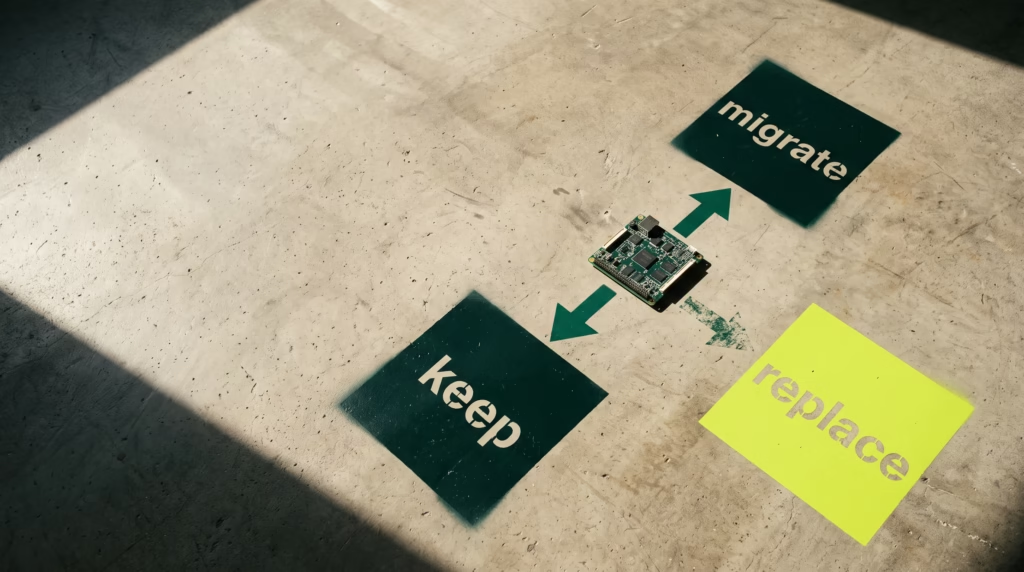
When you buy a UK payment institution, you are not mainly buying its revenue. You are buying its FCA permission and what comes attached to it. That can be a scheme accreditation, a clean licence, a live banking relationship, or a corridor that is hard to rebuild. The revenue matters. The permission matters more.
Two deals in June 2026 showed this in plain terms. A Paris treasury-technology group bought a UK firm to get its Bacs accreditation. A US cross-border firm bought a Dutch business to get a licence it plans to upgrade. Neither buyer paid for size. Each paid for a regulated capability it did not want to build from scratch.
For an SPI or API owner, that flips the question. The question is not only “what does my business earn.” It is “what permission do I hold, and how clean is it.” This article walks through what buyers value, how the buy-versus-build choice really works, and what the June deals tell both sides of a transaction.
What “buy versus build” really means for a UK payment institution
The choice is simple to state. You can apply to the FCA for a new permission. Or you can buy a firm that already holds one. The two routes lead to the same regulated position by very different paths.
Most buyers underestimate the build route. They treat it as a form-filling exercise. It is not.
How long the build route takes
A new authorisation runs on a regulatory clock. Under the Payment Services Regulations 2017, the FCA must decide a complete application within three months. If the application is incomplete, the clock can run up to twelve months. Those are the statutory limits, not the typical experience.
The typical experience is longer. The FCA’s own data shows an average determination of around five to six months for Authorised Payment Institution applications. Once you add the preparation time before you file, real timelines run from six to twelve months end to end. A weak application can take eighteen months or more, or be sent back and resubmitted.
Small Payment Institution registration is faster, often three to six months. It is also more limited, which we cover below.
The point for a buyer is not the exact month count. The point is the uncertainty. You do not control the FCA’s questions. You cannot promise a launch date to a board or an investor. And there is no guaranteed outcome at the end.
How the buy route works
Buying an authorised firm gives you the permission that already exists. You do not start the clock again. You take over a firm that the FCA has already authorised.
There is still an FCA step, and it is the one most buyers misjudge. The permission does not transfer by itself. A change of control needs FCA approval. We return to that gate later, because it sets the timing and part of the price.
The real trade-off is clear. The build route trades time and certainty for a clean start. The buy route trades a clean start for speed, but it carries the history of the firm you acquire. That history is exactly what diligence is for.
SPI, API or EMI: which permission are you buying?
These are three different permissions, and they are not interchangeable. A specialist buyer treats them as three separate decisions.
A Small Payment Institution (SPI) is the lighter-touch tier. It is open to firms whose payment transactions average no more than three million euros a month over a year. An SPI faces lighter capital rules. It also cannot passport into other countries, and it is capped by that volume threshold.
An Authorised Payment Institution (API) has no volume cap. It carries full prudential requirements. Its initial capital sits between twenty thousand and one hundred and twenty-five thousand euros, depending on the services it provides.
An Electronic Money Institution (EMI) is authorised under the Electronic Money Regulations 2011. It issues e-money, and its initial capital starts at three hundred and fifty thousand euros.
The gap between a small permission and a full one is the part buyers miss most often. A UK Small EMI registration is not the same asset as a full Authorised EMI. Upgrading from one to the other is its own regulatory project, with its own time and cost. If your plan depends on the upgrade, price the upgrade, not just the entity you are buying.
Why a clean licence is worth more than the revenue attached to it
A licence on a weak control framework is not a clean asset. Buyers know this. The permission only holds its value if the safeguarding, financial-crime controls and ownership behind it are sound. We have written separately on how two June failures showed what happens when they are not. For this article, the takeaway is short. A buyer pays a premium for a clean permission and discounts a dirty one. The cleaner the file, the more the licence is worth.
What the June 2026 deals tell buyers and sellers
Two acquisitions in the same week made the same point from different angles. Both are worth reading closely if you sit on either side of a deal.
XFolio buys a Bacs accreditation
On 2 June 2026, XFolio AI, a Paris-based treasury technology group, acquired Absolute Payment Solutions (APS). APS is one of a small number of Pay.UK-accredited Bacs service providers in the UK. Terms were not disclosed.
Read what the buyer paid for. It did not buy scale. It bought a regulated accreditation that is hard to obtain and the mid-market customer base attached to it. The Bacs accreditation supports payroll and direct debit work that businesses rely on every day. That is the asset.
XFolio’s founder, Anis Rahal, was direct about the strategy: organic growth plus targeted acquisitions, backed by institutional investors. This is the founder-led, buy-and-build acquirer. For a UK firm holding a scarce accreditation, this is the kind of buyer now active.
OpenFX buys a licence it can upgrade
The same day, OpenFX agreed to acquire Embed, an Amsterdam-based payments infrastructure firm. Embed holds a Payment Institution licence from the Dutch central bank, which passports across all thirty EEA states. It also holds a UK Small Electronic Money Institution registration.
OpenFX said the deal is its first regulated presence in the EEA and the UK. It also said it intends to upgrade the UK permission to full Authorised EMI status as its next step. The acquisition brings virtual IBANs, multi-party balances, and SEPA, UK Faster Payments and Swiss connectivity.
That single sentence about the upgrade is the whole buy-versus-build calculation, stated by an acquirer. OpenFX did not apply for a UK and EU position from scratch. It bought one, with the rails attached, and set the upgrade as a known next step. Buying the permission was faster than building it.
“The Great Rebundling” and why focused capabilities sell
Both deals sit inside a wider pattern. Money20/20 Europe named one of its 2026 themes “The Great Rebundling.” The idea is that single-feature firms are being absorbed back into larger platforms.
The 2025 deals behind the theme were large. Global Payments agreed to buy Worldpay for 24.25 billion dollars. Mollie acquired GoCardless for 1.05 billion euros. Those are context, not this week’s news, but they set the direction.
The consequence for a focused SPI or API is direct. If you hold a clean capability, a licence, an accreditation, a defensible corridor, you are an acquisition target in a market that is buying capabilities. If you are sub-scale and undifferentiated, the same consolidation works against you. Strategic buyers pay for the piece that fills a gap in their own business. They do not pay for general competence.
There is a timing point inside this. Consolidation cycles lift the price of must-have assets and compress the price of laggards. The period when a capability earns a premium does not last forever.
Why European payment firms sell earlier than they planned
There is a structural reason many UK and European payment firms sell rather than scale. It was the subject of a notable Money20/20 panel.
On 2 June 2026, Klarna chief executive Sebastian Siemiatkowski and Fiserv chief operating officer Takis Georgakopoulos discussed where European payments stands against the US and China. Their conclusion was uncomfortable. Europe builds world-class payment firms and strong regulation. What it does not match is the capital and the commercial environment needed to scale those firms to global size.
Siemiatkowski pointed to the interchange gap as one cause. UK and EU interchange sits at roughly 20 to 40 basis points. The US figure is around 200. That gap is a policy choice, and it shapes how large the industry can grow.
For a founder, this is not a complaint. It is the market they operate in. If real scale needs capital that European investors are unlikely to provide on acceptable terms, then a well-timed sale is the rational plan, not a failure. The practical move is to build the business to be bought from the start. That means a clean cap table, documented technology, transferable contracts, and a defensible licence.
This is the sell-side reading of a buy-side market. The same conditions that make UK firms attractive to acquirers also explain why those firms come to market.
How to price what you are buying or selling
The framework below works for both sides. A buyer uses it to value risk. A seller uses it to prepare and to defend a price.
What to value beyond revenue
Five things carry the value in a UK payment institution deal. Test each one.
- The permission itself. SPI, API or EMI, and whether its scope matches your plan. A permission you have to upgrade is worth less than one that already fits.
- Scheme membership and accreditation. A Pay.UK Bacs accreditation, a rare FCA permission set, or direct scheme access. These are hard to obtain and slow to replace.
- Banking relationships. A live safeguarding bank and clearing access. New entrants often cannot get these quickly. An existing relationship has real value.
- Corridor and customer base. The currency pairs, markets and clients the firm actually serves, and how sticky they are.
- The clean regulatory file. Safeguarding, financial-crime controls and ownership that survive diligence. This is what protects every other item on the list.
Revenue still matters, but it sits inside this list, not above it. A buyer pays for what is hard to rebuild.
The change-of-control gate
The permission does not move with the share certificate. A change of control in a regulated payment firm needs FCA approval.
The regulator assesses the incoming controller and weighs the state of the firm being bought. A clean firm and a credible buyer move through this faster. A firm with open weaknesses adds delay and risk. A deal that drags loses momentum, and a deal that loses momentum often loses price. Build the change-of-control timeline into the deal from the start, not at the end.
Common mistakes at the deal table
Four mistakes recur. Each is avoidable.
- Paying for revenue, not permission. The revenue can move. The clean permission and the relationships are harder to replace. Price those.
- Treating a small permission as a full one. A Small EMI is not an Authorised EMI. An SPI is not an API. The upgrade has a cost and a timeline. Price the upgrade.
- Treating SPI and API the same in diligence. They carry different thresholds, capital and limits. The same checklist for both is a generalist’s error.
- Leaving change of control to the end. It sets the timing and part of the price. It belongs in the plan from day one.
What is changing in UK payments M&A in 2026
The direction for the rest of 2026 is set by two forces already visible in the June deals.
First, consolidation is active and selective. Founder-led buy-and-build acquirers, like the XFolio model, are hunting scarce capabilities in the UK mid-market. Better-capitalised platforms from outside the UK, like the OpenFX model, are entering through acquisition rather than slow application. Both buyer types pay for permissions and capabilities, not for general scale.
Second, the capital gap is not closing quickly. The structural point the Money20/20 panel made will keep pushing strong UK firms toward trade sales. That sustains buy-side demand and gives well-prepared sellers a real market.
For SPI and API owners, the practical reading is steady. Know which permission you hold. Keep its file clean. Understand the upgrade path if your value depends on it. And treat your licence as the asset it is, because a buyer already does.
Frequently asked questions
Is it faster to buy a UK payment institution or apply for a new licence? Buying is usually faster. A new FCA authorisation runs to a statutory three-month decision for a complete application. But real timelines run six to twelve months once preparation is included, and longer if the application is weak. Buying an authorised firm secures the permission already granted, subject to FCA change-of-control approval.
What is the difference between an SPI and an API in the UK? A Small Payment Institution is limited to payment transactions averaging no more than three million euros a month over a year. It has lighter capital rules and cannot passport. An Authorised Payment Institution has no volume cap, carries full prudential requirements, and holds initial capital between twenty thousand and one hundred and twenty-five thousand euros.
Can you upgrade a UK Small EMI to a full Authorised EMI? Yes, but it is a separate regulatory project, not an automatic step. It carries its own time, cost and FCA scrutiny. If an acquisition depends on the upgrade, the cost and timeline of that upgrade should be priced into the deal, not assumed.
What does FCA change of control involve when buying a payment institution? A change of control requires FCA approval before completion. The FCA assesses the incoming controller and the state of the firm being acquired. Approval timing depends on the quality of the firm and the buyer. Weak controls or an unclear owner add delay and risk to the deal.
What do buyers actually value in a UK payment institution? Buyers value the permission, scheme memberships and accreditations, live banking relationships, the corridor and customer base, and a clean regulatory file. Revenue matters, but the hard-to-rebuild regulated capability is what commands the premium. A clean licence is worth more than the revenue attached to a weak one.
How long does FCA authorisation take in 2026? The statutory limit is three months for a complete application and up to twelve months for an incomplete one. The FCA’s own data shows an average of around five to six months for Authorised Payment Institution applications. With preparation, plan for six to twelve months end to end, and longer for a weak application.
Conclusion
When you buy a UK payment institution, you are buying a regulated permission and what is attached to it. The June 2026 deals proved it twice. XFolio paid for a Bacs accreditation. OpenFX paid for a licence it could upgrade. Neither paid for scale.
Three takeaways follow. For buyers, value the permission, the accreditation and the clean file above the revenue line. For sellers, the capital gap that pushes firms to market also gives you a real buyer pool, if your file is ready. For both sides, the change-of-control gate sets the timing and part of the price, so plan it from the start.
Vertice Fintech brokers SPI and API transactions in the UK, on both sides, and manages the change-of-control handover. If you are weighing a purchase or an exit, talk to Rodolfo Basilio.
Suggested metadata
- Title tag: Buying a UK Payment Institution in 2026: What Buyers Pay For (60 chars)
- Meta description: What acquirers actually pay for when buying a UK SPI, API or EMI in 2026, what the June deals show, and how buy versus build really works. (139 chars)
- URL slug: /insights/buying-a-uk-payment-institution-2026
- Schema: Article + FAQPage (JSON-LD). FAQ block maps to the six questions above.
- Internal links: link “two June failures” reference to the safeguarding/diligence article; link “change-of-control” to a future change-of-control cornerstone; link SPI/API definitions to a future SPI-versus-API explainer.